The Recurring Signature
THE GEARS OF LOST KNOWLEDGE — Post 6 of 10 by pazooter

In Post 5, we walked through the dated sequence—167 BCE to 88 CE—that dismantled the network behind the Antikythera Mechanism. Eleven events across two and a half centuries. No single one intended to end a knowledge tradition. All of them together, doing exactly that. This post steps back from the specific case and asks: does that sequence have a shape? Does it recur? The answer is yes—and once you see the shape, you start seeing it everywhere. But first, a line needs to be drawn. Because not every knowledge tradition that disappears is a loss.
The Pattern, Stated Plainly
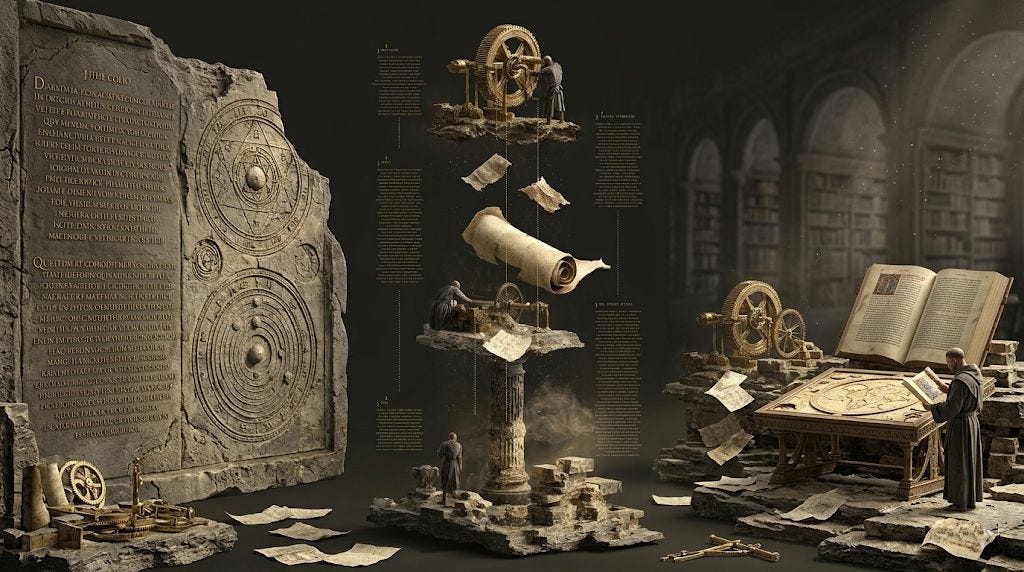
The story of the Antikythera Mechanism is not a unique story. It is an instance of a pattern. Once you’ve seen that pattern laid out clearly, it becomes recognizable across history—in cases separated by centuries, continents, and languages, but running through the same four stages every time.
This pattern describes a specific kind of loss: knowledge the world would want back if it understood what was gone. Knowledge that was displaced rather than superseded—destroyed or dispersed before it could be transmitted, not retired because something better came along. The distinction matters, and we’ll come back to it. For now, here are the four stages.
Stage one. Knowledge becomes encoded in products rather than transmitted as understanding. The device works. The user turns the crank and gets the answer. The maker’s knowledge stays inside the machine. The gap between what the product can do and what the user understands about how it does it gets wider over time.
Stage two. The institutional conditions that supported the knowledge tradition come under pressure—political, economic, military, or some combination. The institutions are disrupted or destroyed. The transmission chains break. The practitioners scatter or die.
Stage three. The products survive longer than the knowledge that produced them. Users keep operating them, maintaining them imperfectly, copying them with degrading accuracy. Each copy is a little further from the original. The knowledge required to hold the standard is quietly draining away.
Stage four. Eventually the products wear out or are destroyed. What remains is textual description—accounts that capture the phenomenon from the outside, what the thing looked like, what it did. The operational core is gone. The description survives. The gap opens.
That is the Antikythera pattern. And it has been running throughout human history, in case after case, with enough consistency to suggest that it reflects something structural—not about specific empires or specific disasters, but about how complex knowledge is built, housed, and lost.
Four cases below. Each one is the same story told in a different time and place.
The Library That Didn’t Burn in a Night
The Library of Alexandria is the most famous knowledge loss in history. It is also probably the most misunderstood.
The popular version goes: one catastrophic fire, everything gone. A single night, a single act of destruction, the ancient world’s accumulated wisdom turned to ash.
That is not what happened.
What happened was slower, less dramatic, and more instructive. The Library declined across three centuries, losing institutional capacity piece by piece as its funding was redirected, its staff scattered, its collections damaged and incompletely restored. By the time the final dissolution came, most of what mattered was already gone—not from fire, but from slow institutional exhaustion.
The critical distinction is this: the Library was not just a building full of scrolls. It was a living intellectual community—a place where knowledge was actively produced, not merely stored. Scholars argued with each other, corrected each other, and built on each other’s work. The community was the Library’s key value. When that community dissolved, the building became what any empty archive eventually becomes: a collection of objects that fewer and fewer people knew how to read.
Many of the scrolls were copied elsewhere. The texts, in that narrow sense, survived—filtered, degraded, but recoverable in fragments through successive transmission. What did not survive was the community that had known how to ask the right questions of them.
The fire is a satisfying story. It has a villain, a moment, a clear cause and effect. The actual story—three centuries of slow institutional decline, the living intellectual community dying long before the building did—is harder to hold in the mind. But it is the story the pattern predicts. And it is the story that matters if you want to understand what knowledge loss actually looks like in progress.
The Codices That Burned in an Afternoon
The Maya case is the opposite kind of story. Here, the loss was sudden. Here, there was a villain, a moment, a single act.
The Maya produced hundreds of bark-paper books—called codices—encoding astronomical observations, calendar calculations, historical records, and ritual procedures that had been refined over at least a millennium. The Dresden Codex alone contains observations of Venus so precise that modern analysis places them on par with contemporary measurements. These were not primitive records. They were the product of a sophisticated astronomical tradition, carefully maintained and transmitted across generations.
In July 1562, the Spanish Franciscan friar Diego de Landa ordered virtually all of them burned in a single public burning in the town of Maní, in what is now Mexico. He described the act as the destruction of superstition. Thousands of objects were destroyed alongside the books—idols, ritual artifacts, the accumulated material culture of a civilization.
Four codices survived, almost certainly because they had already left the Yucatán Peninsula and made their way to European collections before the burning. Modern analysis of those four books is enough to establish what the others contained. It is not enough to recover it.
De Landa, in a bitter historical irony, later wrote a detailed account of Maya culture and language—including the very practices he had burned—in an attempt to preserve what he had destroyed. The account is invaluable. It is also exactly the kind of textual description that survives when the living tradition does not: precise enough to show the outline of what was lost, insufficient to restore it.
This is Stage Four of the pattern, arrived at by a single catastrophic act rather than centuries of slow exhaustion. The result is the same. The description survives. The standard does not.
The Navigators Nobody Recorded
The most invisible losses in history are the ones that left no textual record at all—because the knowledge was never written down to begin with.
The Polynesian navigators who settled the Pacific Islands—finding landfall across thousands of miles of open ocean using stellar positions, wave patterns, bird behavior, and sea phosphorescence—were operating one of the most sophisticated wayfinding systems in human history. Their knowledge was encoded not in documents but in chants, in physical models made of sticks and shells, and above all in the body: in the specific, trained sensitivity of a navigator who had spent enough time at sea to feel the deep ocean swells beneath the surface chop and know, from their direction, what island lay three days ahead.
That knowledge was transmitted through an apprenticeship system that required years of sailing under a master’s correction. It required a community of practitioners large enough to sustain that training across generations. It required, in other words, exactly the kind of institutional continuity that colonial disruption systematically destroyed.
In some Pacific communities, the tradition survived. In others, it was lost—not burned, not looted, but interrupted. A generation without masters to learn from. A community dispersed or depleted. The knowledge that had guided the settlement of an ocean simply stopped being passed on.
What makes this category of loss particularly difficult to reckon with is the invisibility problem. When a library burns, you can see the ash. When a text is destroyed, you can sometimes reconstruct what it contained from secondary references. When an oral, embodied tradition ends, the loss is invisible from the outside—because there was never a record of what was there to lose. The historical account shows a gap but does not show what filled the gap, because what filled the gap was never in the record.
The Antikythera Mechanism is an exception to this problem: we have the physical object, which holds the embodied knowledge of the craftsmen who made it even though those craftsmen left no text. The Pacific navigation tradition had no such exception. When the practitioners were gone, the knowledge was gone.
The House That Took a Week to Destroy
In 1258, the Mongol army under Hulagu Khan sacked Baghdad, ending the Abbasid Caliphate and destroying the House of Wisdom—the great translation and research center that had made Baghdad the intellectual capital of the medieval world for four centuries.
Contemporary accounts describe the Tigris running black with ink from the dumped books. Modern historians are more cautious about the extent of the physical destruction—some of the collections survived, some scholars escaped, and the full story is more complicated than the image of a river of ink suggests. But the institutional destruction was total. The scholars dispersed. The patronage networks that had funded their work collapsed. The specific cross-cultural synthesis that had made the House of Wisdom productive—Greek texts, Persian administrative traditions, Indian mathematical knowledge, Arab observational astronomy, all flowing together in a single place—was ended in days.
What had taken four centuries to build took about a week to destroy.
The House of Wisdom is particularly important in this story because of its role in the chain connecting the ancient world to the modern one. It was through the Arabic translations produced there—and through the subsequent Latin translations of those Arabic texts—that the Greek astronomical and mathematical knowledge underlying the Antikythera Mechanism eventually reached medieval Europe and, eventually, Copernicus, Galileo, and Newton. The House of Wisdom was not the origin of that knowledge. It was the bridge. When the bridge was destroyed, the transmission chain was cut—not completely, but severely. What passed through afterward passed through with more loss at each step.
The Antikythera pattern, again. Knowledge concentrated in an institutional node. Node destroyed. Products and texts survive in fragments. The living community that knew how to use them, gone.
What This Pattern Is Not
Before drawing conclusions, a line needs to be drawn—because the pattern described above can be confused with something that looks similar but is fundamentally different.
Consider the buggy whip. By 1920, the craftsmen who made them were losing their livelihoods. Workshops were closing. Transmission chains were breaking. Knowledge built up over generations of leather work and spring steel was becoming commercially worthless. Run that through the four stages above and it looks like the Antikythera pattern.
It isn’t.
The buggy whip didn’t disappear because an empire collapsed its institutional container or a bishop burned its records. It disappeared because the automobile was a better solution to the underlying problem. The horse was superseded. The whip went with it—not destroyed, not lost, but retired. And critically: the knowledge didn’t actually vanish. It migrated into harness-making, equestrian equipment, specialty leather goods. The craft traditions adapted, shrank to their actual remaining market, and survived in the niches where they were still needed. Nobody is worse off for the absence of a thriving buggy whip industry.
The diagnostic question that separates the two patterns is: did the world lose something it would want back?
For Roman concrete, Damascus steel, the Maya codices, the Pacific navigation traditions—yes. These were capabilities ended before their time, by force or disruption rather than by a better alternative arriving. The world is poorer for their absence in ways it can barely measure, because the vocabulary for naming what was lost often went with the loss itself.
For buggy whips—no. The market correctly retired an inferior solution. That is not loss. That is how progress is supposed to work.
The reason this distinction matters reaches well past historical tidiness. It cuts directly into the present. Some of what new technologies displace will always be the buggy whip case: tasks that were always just a means to an end, now served better another way. Replacing those is not a loss to mourn. But some of what gets displaced may be the Antikythera case—embodied expertise, calibrated judgment, keeper-class knowledge that looks like overhead right up until it’s gone, and then turns out to have been load-bearing.
The hard part is that from inside the transition, the two patterns are nearly impossible to tell apart. Which makes the next question the most important one the pattern poses: how do you know, while it’s happening, which kind of displacement you’re watching?
The honest answer is: you often don’t. What you can do is look for the conditions that distinguish them. Supersession (replacement by a genuinely better alternative) leaves a better alternative behind. Displacement leaves a gap. Supersession is visible in what arrives. Displacement becomes visible—if at all—only in what fails to arrive later, when the gap finally shows itself.
The Hellenistic world didn’t know it was watching displacement rather than progress. Neither did Rome.
What the Pattern Tells Us
Four cases. Different continents, different centuries, different causes. But the same structure—and now, with the obsolescence distinction in hand, we can say more precisely what that structure is tracking: not all change, not all displacement, but the specific kind of loss that leaves the world with a capability it no longer has and cannot easily reconstruct.
The pattern is not a historical curiosity. It is a diagnostic tool. Once you can see its shape, you can recognize it in the present—not just after the loss has happened, but during the conditions that make loss possible.
The conditions that made the Hellenistic knowledge network fragile were identifiable before the collapse: knowledge encapsulated in products without being transmitted as understanding, institutional containers dependent on a narrow set of patrons, embodied knowledge traditions with no written backup, commercial client bases that could evaporate with political change. Any of these, under sufficient pressure, starts the sequence.
Catastrophic knowledge loss of this kind does not announce itself. It proceeds quietly, through ordinary disruptions, until the last practitioner dies and the knowledge goes with them—and by then, from the outside, it can look exactly like a buggy whip industry that simply ran its course. That is what makes it dangerous. Not the drama of the burning, but the silence of the gap.
Next: The Machine We Are Building—the AI parallel. Knowledge encapsulation, the user/maker asymmetry, the nomenclature problem live in real time, and the concentration of a knowledge tradition that is already running the Antikythera pattern in the present tense.
References
Landa, D. de. Relación de las Cosas de Yucatán (c. 1566; translated by Alfred M. Tozzer, 1941). — Primary source for the Maní burning and de Landa’s account of Maya culture; the document from which the post’s irony about de Landa’s preservation effort is drawn
Coe, M., Houston, S., Miller, M., and Taube, K. “The Fourth Maya Codex.” Maya Archaeology 3 (2015). — Scholarly authentication of the Grolier/Maya Codex of Mexico as the fourth surviving codex
Gutas, D. Greek Thought, Arabic Culture: The Graeco-Arabic Translation Movement in Baghdad and Early Abbasid Society. Routledge, 1998. — Standard scholarly reference for the House of Wisdom’s translation program and its role as the bridge between ancient Greek knowledge and medieval Europe
Avari, B. Islamic Civilization in South Asia. Routledge, 2013. — Background on the Mongol destruction of Baghdad and the dispersal of the House of Wisdom’s scholars
I know you are headed to "What is A.I. going to do for/to us;" and I'm interested in how you attack this question. Clearly, it has already started some changes - Just read the last few days of "ZITS." :-)