What Rome Did
THE GEARS OF LOST KNOWLEDGE — Post 5 of 10 by pazooter

In Post 4, we looked at what technological loss actually looks like—Stradivari’s violins, Greek fire, Roman concrete, Damascus steel—and the structural pattern they all share: the products survive, the process doesn’t. This post is about the specific sequence of events that produced the most dramatic case of all
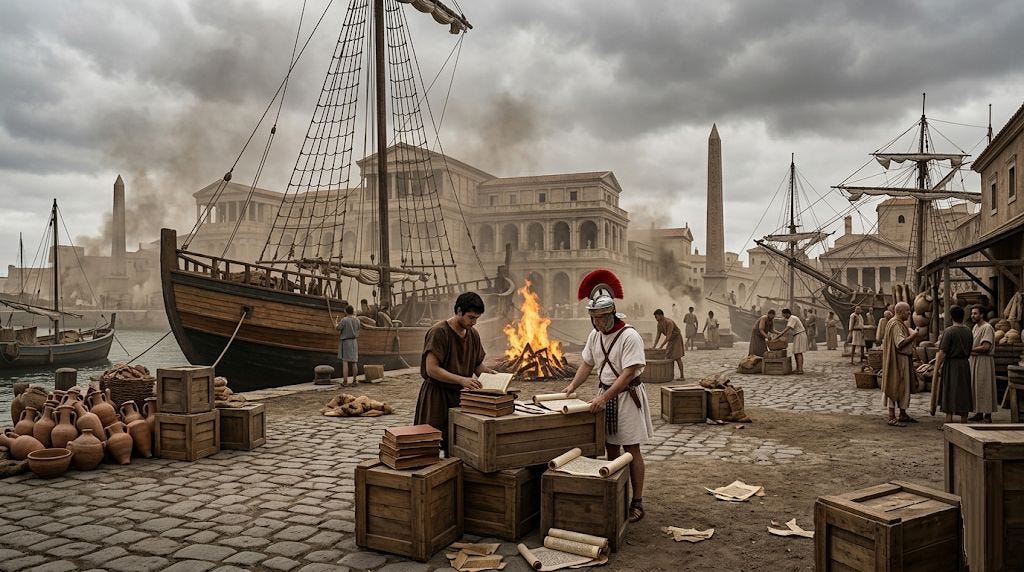
Not a Policy. A Consequence.
It is tempting to frame Rome as a villain in this story. An empire rolls in, destroys the libraries, burns the books, and two millennia of accumulated knowledge goes dark.
That is not what happened. It is important to be precise here, because the accurate version is more disturbing than the simple one.
Rome did not set out to destroy the knowledge network of the Hellenistic Mediterranean. It set out to extract value from it—the art, the scholars, the skilled craftsmen, the commercial revenues, the military technologies—while subordinating the political structures that had organized and sustained it.
The destruction was a consequence, not a policy. But the consequence was total.
What follows is the dated sequence. Eleven events across two and a half centuries. No single one of them was intended to end a knowledge tradition. Together, they did.
The Sequence
167 BCE. Rome politically subordinates Rhodes after the Third Macedonian War. The city had stayed neutral during the war—a reasonable diplomatic position that Rome chose to punish. The punishment was not military destruction. It was economic: Rome transferred the lucrative trade concessions that had made Rhodes wealthy to the island of Delos, collapsing Rhodian commercial revenue by an estimated eighty-five percent within a decade.
The philosophers and astronomers didn’t leave overnight. Hipparchus continued working on Rhodes for another generation after this blow. But the institutions that had paid for his work—and that would have paid for the next Hipparchus—were already starving. The node that had been integrating the Mediterranean’s distinct knowledge traditions began to come apart.
The Antikythera Mechanism—thirty bronze gears, tolerances unmatched for fourteen hundred years, capable of predicting eclipses decades in advance—was built within a generation of this event. It may have been built in partial awareness that the conditions producing it were ending.
146 BCE. Rome destroys Carthage and Corinth in the same year. Two of the most significant commercial centers in the Mediterranean, eliminated within months of each other. This was not subtle. Every remaining Hellenistic state understood the message: alliance with Rome meant subordination, and subordination meant the end of independent commercial and political life.
133 BCE. Attalus III, the last king of Pergamon, dies and bequeaths his kingdom to Rome. Pergamon had been home to the second-greatest library in the ancient world—collections that rivaled Alexandria’s. The library’s scrolls eventually made their way to Alexandria. The institutional context that had made the library a living intellectual center—the patronage networks, the resident scholars, the ongoing research—did not transfer with the scrolls. What Rome inherited was an archive. What it ended was a community.
86 BCE. Sulla sacks Athens during the First Mithridatic War, looting its philosophical schools and shipping their libraries back to Rome. The Athenian philosophical tradition continued in diminished form, but its material resources were gone. What had been a working intellectual infrastructure became a cultural trophy.
Between 70 and 60 BCE. The Antikythera Mechanism sinks to the bottom of the sea. It was in transit—a custom-built instrument, already paid for, being shipped to a client in northwest Greece. It sank mid-collapse. Not after the network was gone. While it was going.
48–47 BCE. Julius Caesar‘s siege of Alexandria results in a fire that destroys an unknown portion of the Library‘s contents. Ancient sources disagree about how much was lost. What is not disputed is that this marks the beginning of a long institutional decline. The Library continued to function, but its role shifted—from a place where knowledge was actively produced to a place where knowledge was passively stored. The difference between those two things is everything.
30 BCE. Rome annexes Egypt, converting the Ptolemaic kingdom into a Roman province. The Ptolemies had funded Alexandria’s intellectual institutions for two and a half centuries. Roman provincial administration was not designed to do that. The Library continued to exist. It no longer continued to matter in the same way.
75 CE. The last known Babylonian cuneiform astronomical text is written.
This deserves to be read slowly. The astronomical diary tradition had been running continuously for at least five centuries. These were the records that supplied the observational foundation for the mechanism’s eclipse predictions—five hundred years of nightly sky observation, carefully logged in cuneiform, maintained by hereditary priestly families inside the temple complexes of Babylon and Uruk. The tradition did not end because the records were burned or the tablets were smashed. It ended because the specialized scribal training required to continue it—a training that took years to complete and was passed down within specific family lines—could no longer be sustained inside provincial temple institutions that had been stripped of the resources to maintain it.
The last diary was written during the Pax Romana—Rome’s great period of peace and prosperity. Not during the civil wars. Not during the conquests. During the peace.
The Three Phases
The sequence above is not random. It has a structure. The collapse ran in three distinct phases, and understanding that structure is what makes the pattern recognizable when it recurs.
Phase one: The Republic breaks the network through conquest and economic reorganization. Rhodes is subordinated. Corinth is destroyed. Athens is looted. Pergamon is absorbed. The patronage networks that had sustained the Hellenistic knowledge tradition are starved of revenue. The institutions survive in form but lose their financial foundation. The next generation of Hipparchus never gets funded.
Phase two: A century of Roman civil war—Marius against Sulla, Caesar against Pompey, Antony against Octavian—finishes what conquest started. A Mediterranean in open internal conflict is not a Mediterranean in which any institution can plan across generations. The Hellenistic knowledge networks lost not just revenue and political protection during this period but something harder to replace: the reasonable expectation of continuity that long-term knowledge transmission requires. You cannot train an apprentice for a decade if you are not confident the workshop will exist in a decade.
Phase three: The Pax Romana makes the collapse invisible. When the wars ended, Rome brought stability, prosperity, and two centuries of relative peace. For Roman culture, this was the golden age. For the knowledge traditions that had produced the mechanism, that stability changed nothing—because the damage was already done. The institutions had already lost their political independence, their revenue, and their trained personnel. What the peace removed was the obvious explanation. There were no more conquests to point to, no more wars to blame. Just the slow and undramatic exhaustion of institutions running on empty. The last Babylonian cuneiform astronomical text was not a protest. It was not a final act of defiance. It was just the last entry, written by the last person still doing the work, in an institution that had quietly run out of everything it needed—during the most peaceful period the Mediterranean world had ever seen.
What This Cost
The fourteen-hundred-year gap—from the Antikythera Mechanism to the next comparable mechanical device—is not just a gap in mechanical sophistication. It is a gap in a specific kind of knowledge synthesis: the capacity to hold multiple distinct traditions simultaneously and find the common structure that makes them talk to each other in a working device.
Medieval European astronomy had access to Aristotle and Ptolemy. It did not have access to the Babylonian observational records that had given Greek astronomy its empirical foundation. It worked with a partial record—filtered through multiple transmission cycles, degraded at each stage, missing the most operationally precise layers of the original tradition.
The result was an astronomy that was sophisticated in its geometric models and imprecise in its empirical predictions. The astronomical tables used for navigation, calendar calculation, and astronomical practice accumulated errors that their users could detect but not correct—because the observational foundation that would have allowed correction was no longer accessible. Columbus‘s most consequential navigational error—underestimating the Earth’s circumference by roughly a quarter—flowed from a misreading of an Arabic degree calculation that had passed through multiple transmission cycles before reaching him. The original precision had not survived the journey intact.
That loss did not happen in a day, or a decade, or even a century. It happened across a sequence of eleven events, none of which was designed to produce it, all of which together did.
The mechanism sank mid-sequence. A custom product in transit, built by a workshop that may already have known the world producing it was ending, en route to a client who never received it.
It fell to the bottom of the sea—and the sea kept it safe from everything that came next.
Next: The Recurring Signature—Alexandria, the Maya codices, the Pacific navigators, the Baghdad House of Wisdom. The four-stage collapse pattern stated plainly, and the pivot from ancient history to structural recurring pattern.
References
Polybius, Histories 30.31. — Primary ancient source for Rhodian harbor revenue decline (1 million to 150,000 drachmas, ~85%) following the declaration of Delos as a free port
Sachs, A. and Hunger, H. Astronomical Diaries and Related Texts from Babylonia, Vols. I–III. Vienna: Österreichische Akademie der Wissenschaften, 1988–1996. — Definitive edition; last Astronomical Diary 61 BCE; last known cuneiform astronomical text 75 CE
Freeth, T. et al. “Decoding the ancient Greek astronomical calculator known as the Antikythera Mechanism.” Nature 444, 587–591 (2006). — Mechanism dating and construction analysis
Neugebauer, O. A History of Ancient Mathematical Astronomy. Springer, 1975. — Foundational reference on the Babylonian observational tradition and its transmission
By just replacing a few words from your Post, I envision today: "America in open internal conflict is not a country in which any institution can plan across generations. Our knowledge networks lose not just revenue and political protection during this period but something harder to replace: the reasonable expectation of continuity that long-term knowledge transmission requires. You cannot train an apprentice for a decade if you are not confident the workshop will exist in a decade."