The Machine We Are Building
THE GEARS OF LOST KNOWLEDGE — Post 7 of 10 by pazooter

New here? A quick catch-up: This series uses a single bronze artifact—the Antikythera Mechanism, a hand-powered calculating device built around 150 BCE that predicted solar and lunar eclipses decades in advance using at least thirty interlocking gears—as a window into how complex knowledge gets built, lost, and why the same pattern keeps recurring. Posts 1 through 6 traced that pattern from ancient Rhodes to Alexandria, the Maya codices, the Baghdad House of Wisdom, and beyond. This post is where the series turns to face the present.
The Parallel Nobody Is Talking About
There is a machine being built right now that is, in structural terms, the most direct parallel to the Antikythera Mechanism that human history has yet produced.
It is called artificial intelligence.
That claim needs to be made carefully, because the easy comparisons—ancient wonder, modern wonder, look how clever we are—are exactly the kind of surface reading this series has been pushing against since Post 1. The parallel is not about impressiveness. It is structural. It runs through the same diagnostic features that made the Antikythera Mechanism fragile in the first place: knowledge locked inside a device that users can operate but cannot understand, a small group of makers holding the knowledge that everyone else depends on, and precise vocabulary degrading in real time as it spreads outward from the people who built the thing to the people who use it.
Let’s go through each of these in turn.
Knowledge Locked Inside the Machine
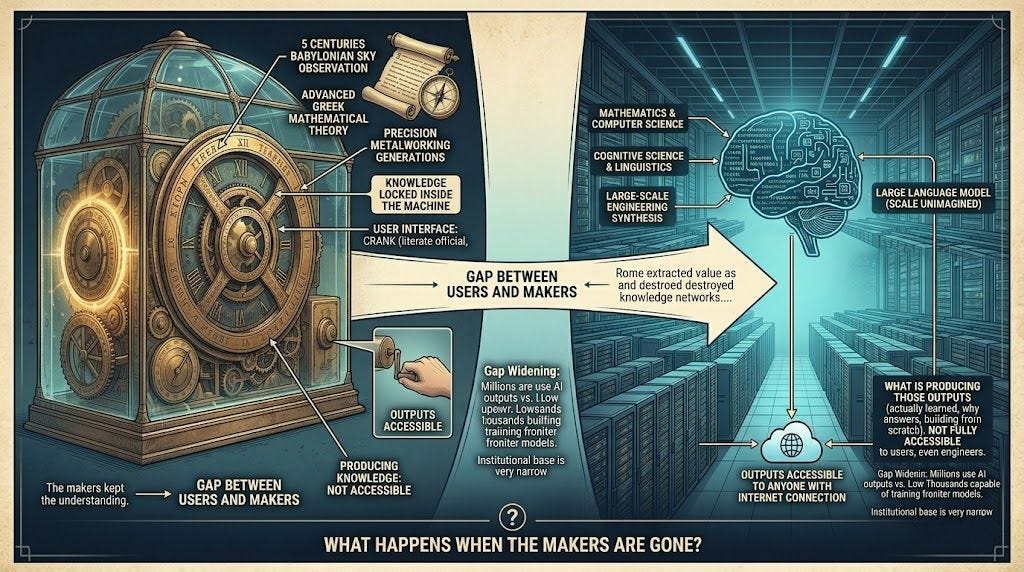
The Antikythera Mechanism encapsulated five centuries of Babylonian sky observation, the most advanced Greek mathematical theory of its day, and precision metalworking techniques developed over generations of Hellenistic craft—all inside a device that any literate official could operate by turning a crank. The outputs were accessible to anyone. The knowledge producing those outputs was not.
A large language model works the same way, at a scale the mechanism’s makers could not have imagined. The outputs are accessible to anyone with an internet connection. What is producing those outputs—what the model has actually learned, why it gives the answers it gives, what it would take to build one from scratch—is not accessible to the vast majority of people using it. In important ways, it is not fully accessible even to the engineers who built it.
This is not a criticism of AI. It is a description of a structural condition. The same gap existed in the mechanism. The mechanism’s users got the answers. The makers kept the understanding.
The question the series has been asking all along is: what happens when the makers are gone?
The Gap Between Users and Makers
In the ancient world, the number of people who could have built the Antikythera Mechanism from scratch was very small—probably a handful of individuals at a handful of institutions, all concentrated in a specific part of the Mediterranean. When the network sustaining those institutions collapsed, the knowledge collapsed with it.
The gap between users and makers in AI is not closing. It is widening.
Hundreds of millions of people currently use AI outputs. The number of people capable of training a frontier AI model—one of the most powerful systems currently being developed—from scratch numbers in the low thousands. They are concentrated in a small number of companies in a small number of cities. The computational resources required to do that training are beyond the reach of almost any institution outside that group, and the requirements keep growing.
This is not a conspiracy or a deliberate plan to keep knowledge concentrated. It is the natural result of a technology where the costs of building are enormous and the advantages of being first compound over time. But the structural result is the same regardless of the cause: a knowledge tradition whose institutional base is very narrow is fragile in ways that a distributed tradition is not. And the fragility is not visible until the disruption comes.
Rome did not set out to destroy the knowledge network that produced the Antikythera Mechanism. It set out to extract value from that network while reorganizing the political economy around itself. The destruction was a consequence, not a policy.
The question worth sitting with is not whether anyone intends harm. It is whether the conditions being created are the kind of conditions under which knowledge traditions have historically survived—or the kind under which they have not.
The Convergence Nobody Planned
Here is something the automation frame—the dominant public story about AI, which treats it primarily as a faster tool for doing existing tasks—misses almost entirely.
The Antikythera Mechanism was remarkable not because it automated calendar calculations. Plenty of people could do that manually. It was remarkable because it was a synthesis—a single device holding Babylonian astronomy, Greek mathematics, and Hellenistic metalworking simultaneously, finding the common structure that let all three talk to each other.
That synthesis required a specific kind of mind, in a specific kind of institutional context, that was genuinely rare. In the history of the Hellenistic Mediterranean, there may have been only a handful of people capable of holding all three traditions at once.
Modern AI systems are doing something structurally similar at a scale that is hard to take in. They synthesize mathematics, computer science, cognitive science, linguistics, and large-scale engineering—traditions that developed largely independently and are being integrated in real time. Whether this constitutes genuine understanding or something that resembles it from the outside is a question we will return to in Post 10. What is not in question is that the outputs of that synthesis are already producing results that no single human tradition could have reached alone—connections between bodies of knowledge that had never been in contact before.
The mechanism’s synthesis was productive because the traditions it drew on were distinct. It was fragile for exactly the same reason: the people who could hold all of them simultaneously were few, and the institutions supporting their work were not guaranteed. The same is true now.
The Words That Are Degrading Right Now
In Post 3, we looked at what happened to the Babylonian astronomical term AN.MI when it was translated into Greek as ekleipsis—meaning something closer to “abandonment” or “failing to appear.” The Greek word captured the visual phenomenon and lost the predictive content. The surface language and the operational substance came apart. For anyone who read only the Greek inscription, the word looked like knowledge while functioning as something shallower.
The AI field’s vocabulary is going through the same process right now, in real time.
Terms like intelligence, understanding, reasoning, knowledge, hallucination, and alignment are being used with different operational content by different communities simultaneously. What alignment means to an AI safety researcher—a precise technical property relating a model’s behavior to human values—is not what it means in the news coverage of the same research, where it tends to mean something closer to “the AI is well-behaved.” Policy and regulation built on the looser version of the word will systematically fail to address what the technical version identifies.
Intelligence is the most degraded term in the entire vocabulary. It has been used with at least six distinct operational meanings within AI research alone—logical inference, pattern recognition, game-playing capability, language modeling, general problem-solving, and the capacity to learn new tasks quickly—and in dozens more in the surrounding discourse. The public conversation about AI is substantially organized around this word. It is substantially confused as a result.
This is not a complaint about careless journalists or uninformed policymakers. It is a description of a structural problem that has destroyed knowledge traditions before. Precise vocabulary, developed within a living practice, degrades at each step of transmission outward. The people doing the transmitting are not being careless. They are doing the best they can with the vocabulary they have. The operational precision does not survive the translation because the receiving tradition has no category for it.
The Babylonian scribes who translated AN.MI as ekleipsis were not careless either.
The Transmission Problem
There is one more dimension of the parallel that deserves to be named directly.
The earliest large language models—GPT-2, BERT, the original transformer architectures—were built at corporate research labs, but with a critical difference from what came after: their architectures were fully documented in published papers, their trained weights were released openly, and their training procedures could be studied, fine-tuned, and partially reproduced by independent researchers working outside those labs. The knowledge of how they worked was not fully locked away: it was partially transmissible through the normal channels of academic knowledge—published papers, reproducible experiments, open-source code.
Current frontier models are trained on computational resources available only to a handful of companies. The techniques used are not fully documented in public papers. The composition of the training data is not publicly disclosed. The internal workings of the resulting systems are not fully understood even by the teams that built them.
The trend is toward more encapsulation, not less. Each generation of frontier model is harder to independently reproduce, harder to inspect, and maintained by a smaller fraction of the global research community than the one before.
This is not sinister. The economic logic driving it is clear and rational from the perspective of each individual actor following it. When the outputs of a knowledge tradition are valuable and the knowledge producing those outputs is encapsulated inside products, the returns flow to the product makers. The makers reinvest those returns in the capacity to make better products. Better products encapsulate more knowledge. More knowledge concentrates more returns. The cycle accelerates.
The Antikythera Mechanism was built in a network running exactly this logic. And the mechanism’s makers may have been among the last people who understood, in operational terms, what was inside it.
Aware of the Pattern
The one genuine difference between the Hellenistic case and the present one is this: the people building current AI systems are, unusually, aware of the pattern they are participating in. There is a substantial and growing body of work on AI safety, knowledge preservation, and the risks of concentrated capability. That awareness is itself a real difference from what was available to the makers of the Antikythera Mechanism.
But awareness is not protection. The conditions that made the Hellenistic knowledge network fragile were not unknown to the people living inside it. Cicero wrote about the devices in De re publica, using them as demonstrations of Greek ingenuity. He named Archimedes as their maker. He admired what they represented. What he lacked was any mechanism for preserving—or, by most scholarly accounts, any deep engagement with—the institutional conditions that made the tradition possible.
Knowing what is at stake and having the institutional structures to act on that knowledge are different things.
The gears are turning. The question of who is holding the crank—and who will be able to hold it a generation from now—is the question the next three posts are about.
References
Freeth, T., Bitsakis, Y., Moussas, X., et al. (2006). “Decoding the ancient Greek astronomical calculator known as the Antikythera Mechanism.” Nature, 444, 587–591. https://doi.org/10.1038/nature05357
Freeth, T., Higgon, D., Dacanalis, A., et al. (2021). “A Model of the Cosmos in the ancient Greek Antikythera Mechanism.” Scientific Reports, 11, 5821. https://doi.org/10.1038/s41598-021-84310-w
Rochberg, F. (2004). The Heavenly Writing: Divination, Horoscopy, and Astronomy in Mesopotamian Culture. Cambridge University Press.
Vaswani, A., Shazeer, N., Parmar, N., et al. (2017). “Attention Is All You Need.” Advances in Neural Information Processing Systems, 30. https://arxiv.org/abs/1706.03762
Devlin, J., Chang, M-W., Lee, K., & Toutanova, K. (2018). “BERT: Pre-training of Deep Bidirectional Transformers for Language Understanding.” https://arxiv.org/abs/1810.04805
Radford, A., Wu, J., Child, R., et al. (2019). “Language Models are Unsupervised Multitask Learners.” OpenAI. https://cdn.openai.com/better-language-models/language_models_are_unsupervised_multitask_learners.pdf
Legg, S. & Hutter, M. (2007). “Universal Intelligence: A Definition of Machine Intelligence.” Minds and Machines, 17(4), 391–444. https://arxiv.org/abs/0712.3329
Cicero. De re publica, I.21–22. https://www.thelatinlibrary.com/cicero/repub1.shtml
And what about A.I. being constituted in numerous countries, cultures, and languages? Will they end up going to war - A.I., not the countries, etc. :-)
Wait, your sources are Wikipedia????