What Lost Looks Like
THE GEARS OF LOST KNOWLEDGE — Post 4 of 10 by pazooter

In Post 3, we looked at what happens to the words of a knowledge tradition when the tradition dies—how precise operational vocabulary gets hollowed out at each step of transmission until the word survives but the meaning doesn’t. This post is about what happens to the technology itself.
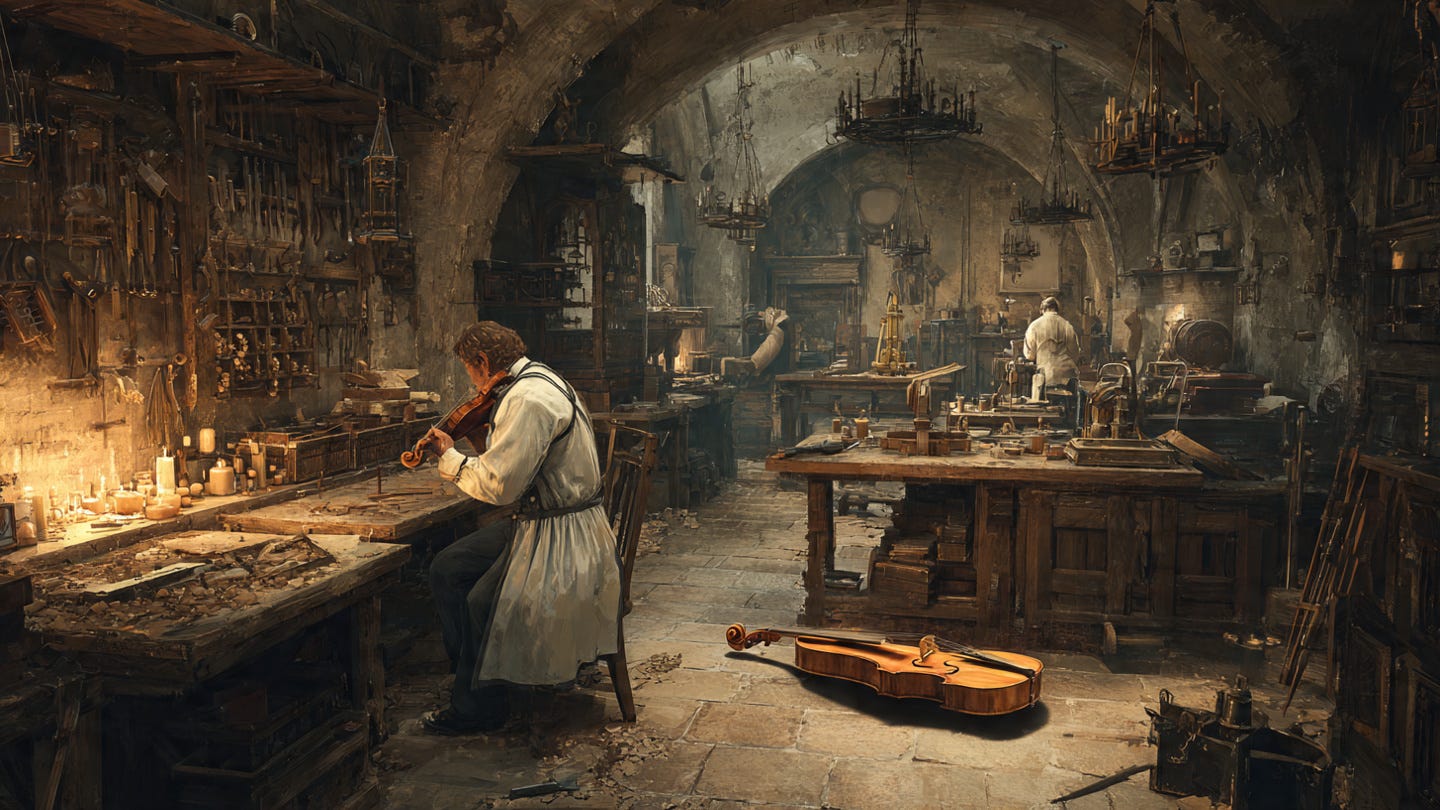
The Violins Nobody Can Copy
In a workshop in Cremona, Italy, a craftsman named Antonio Stradivari built approximately 1,100 stringed instruments across a working life that ran from 1666 until his death in 1737. Around 650 survive. They have not been matched by any instrument maker in the three hundred years since.
This is not for lack of trying. Violin makers, acoustics engineers, and materials scientists have spent two centuries studying Stradivari instruments with every tool available—chemical analysis of the varnish, CT scans of the wood, acoustic modeling of the geometry. The results have been illuminating and insufficient. Researchers have identified factors that likely matter: the density of the Alpine spruce used for the top plates, a varnish chemistry that appears to interact with the wood in unusual ways, geometric proportions held to extraordinary precision. But no one has been able to combine these factors into an instrument that performs the way a Stradivarius performs.
When Stradivari died in 1737, at roughly ninety-three years old, he took his operational knowledge with him. The instruments survived. The knowledge that produced them did not.
This is what technological loss looks like. Not a fire. Not a war. Not a dramatic catastrophe. Just a very old man dying, and no one left who knew exactly what he knew.
The Four Things That Have to Hold
The Stradivari case feels like a personal tragedy—one genius, one lost secret. But the pattern it represents is structural, not personal. It recurs wherever a knowledge tradition reaches a high level of sophistication. And the Antikythera Mechanism—built over two thousand years ago, capable of predicting eclipses decades in advance, unmatched for fourteen hundred years—is the most dramatic example in human history.
To produce that device, four conditions had to hold simultaneously. Lose any one of them, and the device doesn’t get built.
A library system. Not a library in the modern sense of a place to borrow books, but an institution that maintained working copies of technical records across multiple generations, with trained staff who could read them and extract the relevant data. The Antikythera Mechanism’s eclipse predictions were built on five centuries of Babylonian sky observation. Accessing those records required a library with staff capable of reading cuneiform. Alexandria had this. Pergamon had this. Both were absorbed into Roman imperial administration in ways that broke their working function long before their physical contents were damaged.
A patronage system. Hipparchus‘s lunar theory—without which the mechanism could not predict eclipses accurately—was the product of decades of sustained observation and calculation. Work like that doesn’t happen on a commercial timeline. It requires an institution willing to fund a researcher across a full career, with no guarantee of immediate return. The philosophical schools of Rhodes and Athens provided this. When they dissolved under Roman pressure, it ended.
A craft guild system. The gear teeth in the Antikythera Mechanism were cut to tolerances unmatched for fourteen hundred years. That precision didn’t come from a manual. It came from a master metalworker teaching an apprentice, correcting their work, and doing this repeatedly until the apprentice’s hands knew what the master’s hands knew. When Rome conquered the Hellenistic cities, it frequently enslaved the most skilled craftsmen and relocated them—severing the workshop transmission chain at its most critical point.
A commercial client base. The mechanism was a custom product, built for a specific buyer in northwest Greece. That customization implies repeat business. Repeat business implies a market of sophisticated clients—rulers, priests, court astronomers, naval administrators—who understood what they were buying and could pay for it. Rome progressively replaced this client population with Roman patrons who wanted Greek cultural objects as trophies, not as working instruments. The market for precision astronomical devices collapsed with the network that had created it.
All four conditions had to hold at once. Rome eliminated all four—not as deliberate policy, but as the cascading consequence of political and economic reorganization. The tradition didn’t die in a single blow. It exhausted itself slowly, institution by institution, generation by generation. The last known Babylonian cuneiform astronomical text was written in 75 CE—during the Pax Romana, Rome’s period of greatest peace and stability. The tradition didn’t end during Rome’s wars. It ended during Rome’s peace.
Three More Cases
Stradivari is recent enough to feel personal. But the same pattern—embodied knowledge, institutional container, disruption, loss—runs through the entire history of technology.
Greek fire. The incendiary weapon used by the Byzantine navy from the 7th century CE onward could burn on water. It could be projected through tubes at enemy ships. It could not be extinguished by conventional means. It was one of the most strategically decisive weapons in the medieval Mediterranean. Its formula was a state secret, transmitted within a single family of Greek engineers in Constantinople. When Constantinople fell to the Ottoman Turks in 1453, the transmission chain ended. The formula was lost. Modern chemistry has produced plausible reconstructions, but none has been confirmed to match what Byzantine sources describe. The knowledge did not survive its institutional container.
Roman concrete. The hydraulic concrete used in Roman construction—the Pantheon‘s dome, the harbor at Caesarea Maritima, the foundations of the Colosseum—has proven more durable than anything produced by modern construction methods. Core samples from Roman harbor structures show that the concrete actually strengthens over time through mineral crystallization, becoming more resistant to cracking as it ages. The specific combination of volcanic ash, seawater, and lime that produces this effect was understood by Roman engineers and transmitted through a guild system that dissolved with the Western Empire. Medieval European builders could see Roman structures everywhere. They could not reproduce them, because the operational knowledge that had produced them was gone. The formula was reconstructed from materials analysis only in the 21st century.
Damascus steel. The crucible steel produced in the Middle East from roughly the 3rd century CE to the 17th was famous for its distinctive surface patterns, exceptional sharpness, and a toughness that European smelting techniques could not match. It was lost when the trade routes supplying the specific steel ingots from which it was made were disrupted by Persian and British interventions in Indian trade networks. The surface patterns—decorative to the eye—were actually a visible sign of a specific nano-scale structure within the metal, one that required precise temperature control and specific alloy compositions that craftsmen understood through practice but had never written down. Modern metallurgy has identified the structure. Reproducing it consistently is still an unsolved problem.
Each of these cases follows the same pattern. Knowledge that was operational, embodied, and passed down through practice became unavailable when its institutional container was disrupted or destroyed. The products survived. The process did not.
Why Ideas Outlast Techniques, and Techniques Outlast Standards
There is a structural reason this keeps happening, and it comes down to what different kinds of knowledge need in order to survive.
Written knowledge—ideas recorded in texts—can be copied, translated, hidden, and transported independently of the institution that produced it. The works of Aristotle survived the fall of Athens, the fall of Alexandria, and the fall of Rome through successive rounds of copying and translation. Each step filtered something out, but the text remained recoverable. Written knowledge is portable. It can outrun the collapse of the institution that generated it.
Embodied knowledge—knowledge that lives in trained hands, calibrated eyes, practiced judgment—cannot be copied. It requires an unbroken chain of practitioners, each generation learning from the previous one, within an institution stable enough to sustain the full length of an apprenticeship. The bronze-caster who cut the mechanism’s gears to fourteen-hundred-year tolerances did not learn that from a manual. A student worked beside a master long enough to internalize not just the technique but the standard—the felt sense of what good work is before it’s finished, the recognition of a gear tooth cut to the wrong angle before the mechanism drifts. That knowledge lived in the body. When the chain broke, it was gone.
And beneath both of these is the vocabulary—the precise technical language that lets a practitioner name what they are doing, identify where a transmission has fallen short, and describe the knowledge in terms that the next generation can work from even when the chain is under pressure. As we explored in Post 3, that vocabulary is the first thing to degrade.
The result is a hierarchy of fragility. Ideas survive longest. Techniques survive less long. Standards—the lived sense of what good work feels like, held in the bodies of practitioners who have made enough of it to know—are the most fragile element of any knowledge tradition, and the first to disappear when institutional continuity breaks.
The Antikythera Mechanism sits exactly at this intersection. Its mathematical foundations—the Babylonian arithmetic procedures, Hipparchus’s lunar theory—were partly textual, partly preserved, partly recoverable through scholarship. Its craft realization—the specific technique of cutting gears to those tolerances—was entirely embodied. We can reconstruct the mathematics. We can approximate the gears. We cannot recover the craftsman’s knowledge of what good work felt like in the making.
Three hundred years of trying to rebuild a Stradivarius tells us the same thing.
Next: What Rome Did—the dated sequence from 167 BCE to 88 CE. How a Mediterranean knowledge network was dismantled, node by node, over two and a half centuries—and why the tradition didn’t end during Rome’s wars, but during Rome’s peace.
References
Masic, A. et al. “Seawater-based concrete explains why two-thousand-year-old Roman marine infrastructure is still standing.” Science Advances 7 (2021). — Roman harbor concrete mineral crystallization mechanism
Masic, A. et al. “Hot mixing: Mechanistic insights into the durability of ancient Roman concrete.” Science Advances 9 (2023). — Self-healing lime clast mechanism; primary source for Roman concrete claims
Sachs, A. and Hunger, H. Astronomical Diaries and Related Texts from Babylonia, Vols. I–III. Vienna: Österreichische Akademie der Wissenschaften, 1988–1996. — Definitive edition of the Babylonian astronomical diaries; last dated diary 61 BCE; last known cuneiform astronomical text 75 CE
Verhoeven, J.D., Pendray, A.H., and Dauksch, W.E. “The Key Role of Impurities in Ancient Damascus Steel Blades.” Journal of the Minerals, Metals and Materials Society 50 (1998). — Primary scholarly source on the nano-scale carbide structure and loss of Damascus steel production
Now, how to apply these terrific examples to AI ??? <3
Why elders need to teach their "crafts" to those younger when the opportunities arise. For example: home crafts such as cooking, sewing, gardening, and more. Their futures may depend on this knowledge.