The Machine—Inside Out
THE GEARS OF LOST KNOWLEDGE — Post 1 of 10 by pazooter

This is the first of ten posts in The Gears of Lost Knowledge — a series that uses a single ancient artifact as a window into how complex knowledge gets built, transmitted, and destroyed, and why the same pattern keeps appearing in our own time. Each post stands on its own, but the argument builds. You're at the beginning.
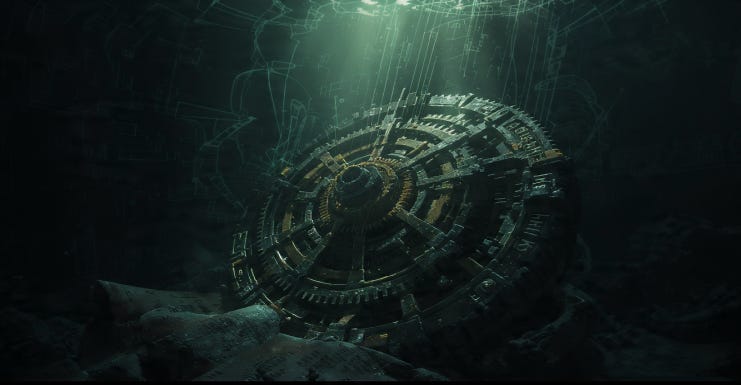
In ancient Rome, there was a type of performer called a haruspex. He used the practice of augury, which involved carefully examining the organs of a sacrificed animal in public and with some pomp and ceremony announcing what the gods intended. In fact it was all theater. His reading of the liver only ever revealed what the powerful people of his day needed him to proclaim as a message from the gods.
This series does something different. Like the haruspex, it looks at a physical object. Unlike him, it follows only what the object itself shows — not what we would like it to mean, not what makes a good story, not what is politically convenient.
The object is a corroded bronze box pulled from a shipwreck off a small Greek island in 1901. Reading it carefully — reading its structure rather than just marveling at its age — reveals something much larger than the object itself. It reveals a pattern. A pattern of how complex knowledge gets built up over generations, how it gets lost, and who benefits when it disappears.
That pattern has repeated itself throughout history. It is repeating right now.
The box is called the Antikythera Mechanism. This series is not really about it. The Antikythera is our way in. What we are walking toward is something closer to the present day.
What They Pulled Up from the Seafloor
In the autumn of 1900, a group of Greek sponge divers took shelter from a storm near the small island of Antikythera. While they waited, one of them looked down. Something was on the seafloor, forty to fifty meters below. They came back the following year with a proper salvage operation and brought it up.
What they found looked like junk. A lump of corroded bronze and rotted wood, roughly the size of a shoebox, broken into pieces. It sat in the National Archaeological Museum in Athens for a full year before anyone noticed that one of the fragments contained a gear wheel.
That gear wheel changed everything — slowly.
The Antikythera Mechanism is a hand-powered bronze calculating device built somewhere between 150 and 205 BCE — more than two thousand years ago. Here is what it could do:
It tracked the sun, the moon, and five planets at the same time. It predicted solar and lunar eclipses decades into the future. It kept track of the four-year Olympic Games cycle and the schedules of regional Greek festivals. It even accounted for the fact that the moon moves slightly faster at certain points in its orbit — a mathematical correction so precise that it wasn’t independently worked out again until the twentieth century.
It did all of this with at least thirty interlocking bronze gears, each one cut to tolerances that no other known device matched for the next fourteen hundred years.
You turned a crank. The dials gave you the answer.
The Wrong Question
When most people learn about the Antikythera Mechanism, they ask: How did they build this?
It is a natural question. The device is extraordinary. The fact that it exists at all feels like a miracle of the ancient world.
But that question leads nowhere useful. It turns the mechanism into a curiosity — a one-off marvel of ancient genius — and leaves it there. Impressive. Isolated. Filed away.
The right question is different: What did building this require — and what happened to all of it?
That question opens something up. The Antikythera Mechanism did not come from nowhere. No single person invented it from scratch. What the device encodes required knowledge that had been accumulating for centuries — in multiple places, in multiple languages, maintained by multiple institutions — all of it flowing together into the hands of whoever built this thing.
The mechanism is not a one-off marvel. It is a single surviving node in a vast network of knowledge, relationships, and institutions that stretched across the ancient Mediterranean world. That network was methodically dismantled within two centuries of this device sinking to the bottom of the sea.
What the Gears Tell Us
We are not guessing about whether other devices like this existed. We have a witness.
Cicero, the Roman statesman and writer, lived at almost exactly the time this device was made. He describes, in his own writing, comparable instruments — one built by Archimedes, another built by his friend Posidonius, a philosopher who worked on the island of Rhodes. Posidonius’s device, Cicero tells us, reproduced the motions of the sun, the moon, and the five planets. None of those instruments survive. Bronze was far too valuable to abandon — when a device wore out or fell out of use, it went back into the furnace. The Antikythera escaped that fate only because it sank to the bottom of the sea before anyone could recycle it.
This changes everything about how we read the mechanism. It is not a lonely wonder. It is the sole physical survivor of a living tradition — the passing of hard-won knowledge from one generation of practitioners to the next — a tradition that Cicero himself witnessed, that involved some of the greatest minds of the ancient world, and that was producing these instruments as a matter of course.
And that tradition is gone. Not quietly retired. Dismantled. The knowledge that produced it — the centuries of astronomical observation, the mathematical theory, the precision metalworking — did not fade away on its own. It was housed in specific institutions, maintained by specific people, and it vanished when those institutions were destroyed and those people were dispersed.
That is the organism the mechanism points to. And the story of how that organism died — and why the same pattern keeps recurring — is what the next nine posts are about.
Next: The Network — Rhodes as integration point, and the transmission chain that put five centuries of Babylonian observation into thirty bronze gears.
References
Freeth, T. et al. “Decoding the ancient Greek astronomical calculator known as the Antikythera Mechanism.” Nature 444, 587–591 (2006). — Primary modern reconstruction; confirms 30 surviving gears and gear tolerances
Freeth, T. et al. “Calendars with Olympiad display and eclipse prediction on the Antikythera mechanism.” Nature 454, 614–617 (2008). — Documents the games-cycle dial and eclipse prediction range
Wright, M.T. “The Planetarium of Archimedes.” Bulletin of the Scientific Instrument Society 83 (2004). — Scholarly analysis of Cicero’s accounts of the Archimedes and Posidonius instruments