The Network
THE GEARS OF LOST KNOWLEDGE — Post 2 of 10 by pazooter

In Post 1, we pulled a corroded bronze box from the bottom of the sea and asked the question that actually matters: not “how did they build it?” but “what did building it require?” This post is the answer.
What the Maker Actually Did
Whoever built the Antikythera Mechanism did something that has no good one-word name. It wasn’t discovery—the Babylonian records already existed, Hipparchus‘s lunar theory already existed, the metalworking traditions already existed. It wasn’t synthesis in the passive sense of assembling known pieces. It was something harder: seeing that five bodies of knowledge developed independently, in different languages, over centuries, could be made to speak to each other—and then working out, from scratch, the physical form that unified them.
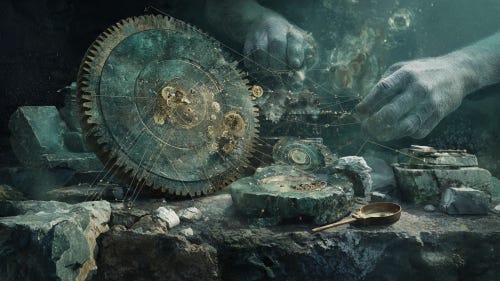
The gear ratios encoding the eclipse cycles, the lunar anomaly correction, the planetary tracks—none of those existed before this device. The maker produced them. And then they got them into metal precise enough to hold for decades.
That is three kinds of intelligence operating as one.
All three of those things had to be present in the same person, at the same time. That is genuinely rare. What that person could not do—what no single person could have done—was supply all of the raw material they were working with. That material came from a network. And the network is what this post is about.
What the Maker Needed
To build this device, the maker needed four things. Lose any one of them, and the device doesn’t get built.
Five centuries of Babylonian sky records. The mechanism can predict eclipses decades in advance. That accuracy does not come from a few years of watching the sky. It comes from five hundred years of careful, continuous observation—tracking the moon, recording the patterns, building up a picture large enough to see the long cycles underneath. Those records existed. They were kept by hereditary priestly families inside the temple complexes of Babylon, Uruk, and Nippur, written in cuneiform on clay tablets. They were not public documents. They were closely guarded, passed down within specific family lines of specialized scribes called the tupšar Enūma Anu Enlil—the keepers of the celestial omen series. The maker used their numbers.
Hipparchus’s lunar theory. The mechanism accounts for the fact that the moon moves slightly faster at certain points in its orbit. That correction—the lunar anomaly—was worked out by the Greek astronomer Hipparchus, working on the island of Rhodes sometime between 150 and 120 BCE. His model was the most precise account of lunar motion that Greek astronomy had ever produced. Without it, the mechanism’s eclipse predictions would drift off over time. With it, they hold.
Precision bronze-working. The gear teeth in this device are cut to tolerances that no other known instrument matched for the next fourteen hundred years. That kind of metalwork didn’t come from Greek tradition. It drew on Mesopotamian and Levantine craft knowledge that had been developing precision metalwork for centuries. It lived in workshops, passed from master to apprentice, and it left almost no written record. The maker either learned it or had access to someone who had.
Civic calendar knowledge. The device tracks the schedules of Greek festivals across multiple regional calendar systems—the Corinthian calendar month names, the Halieia festival in Rhodes, the Naa festival in Epirus. Each of those represented a separate administrative tradition, maintained by a different set of local institutions. The maker knew all of them.
The Workshop and the Client
There is a detail in the mechanism that the wonder-framing tends to skip past. The device’s games dial includes the Rhodian Halieia festival and the Naa festival from Epirus—a region in northwest Greece. That combination is not a scholar’s curiosity. It is a client specification. Someone in northwest Greece ordered this instrument, paid for it, and it was being shipped to them when the vessel went down.
The mechanism was a commercial product. Custom-built. In transit.
This matters for understanding the maker in a way that purely intellectual framing misses. The synthesis of five centuries of observation, Hipparchan mathematics, and precision metalwork did not happen because someone found it interesting. It happened because there was a market for it—rulers, priests, court astronomers, civic officials who needed calendar calculations done accurately without employing a full-time astronomer. The device was the product. The workshop was the business.
Genius without commerce dies with its keeper. What the mechanism’s structure reveals is not just a rare mind but a functioning commercial operation: repeat clients across the Aegean, custom specifications built into the product, a workshop capable of producing instruments to order.
The base instrument is calibrated for Rhodes. The Epirote modification was added for a specific buyer who wanted their local festivals tracked too. This is a workshop that knew its customers.
Rhodes: Where It All Came Together
The easy version of ancient intellectual history gives Alexandria all the credit. This is partly because Alexandria was genuinely important—and partly because the Library of Alexandria generated enormous amounts of writing about how important the Library of Alexandria was. The mechanism points somewhere else.
The geographic evidence in the device itself is clear. The star calendar is calibrated for latitudes consistent with Rhodes. The festivals on the games dial are centered on Rhodes and its trading partners. The calendar month names place the instrument within a commercial sphere that Rhodes dominated.
Rhodes in the 2nd century BCE was the Mediterranean’s most sophisticated crossroads. Babylonian astronomical knowledge arriving from the east, Greek mathematical theory from its own schools, Levantine craft traditions, and western Mediterranean commercial networks all came together in one place with enough institutional depth to do serious work. Hipparchus worked there. Posidonius ran a school there. The city’s commercial law was so respected that Rome later adopted it as the basis for maritime law across the empire.
It was also politically neutral—the city maintained treaties with Pergamon, Egypt, and Rome simultaneously. That neutrality mattered. Long-term intellectual work requires the reasonable expectation that the work will still be funded next year. Rhodes provided that.
When Rome punished Rhodes after 167 BCE for insufficient enthusiasm during the Third Macedonian War, it didn’t level the city. It collapsed its commercial revenue by an estimated eighty-five percent within a decade. The institutions that had supported Hipparchus and Posidonius lost their financial base. The node that had been integrating the Mediterranean’s knowledge traditions began to come apart.
The mechanism was built within a generation of that blow. It may have been built in partial awareness that the conditions producing it were ending.
How Babylon Reached Rhodes
The path by which five centuries of Babylonian sky observation ended up encoded in bronze gears on a Greek island is not a mystery. It is traceable—not completely, but substantially.
Alexander the Great‘s conquest of Mesopotamia in 331 BCE opened the Babylonian temple archives to Greek-speaking scholars for the first time. The Seleucid dynasty that inherited Babylon after Alexander’s death kept the temple institutions running—partly from genuine interest, partly because they were administrative infrastructure the new empire needed. For the first time, Babylonian priestly astronomers and Greek-educated scholars existed in the same world.
Berossus, a Babylonian priest writing in Greek around 290 BCE, is the clearest early bridge. He reportedly moved to the Greek island of Cos, established a school, and began teaching Babylonian astronomical knowledge to Greek students. His books—almost entirely lost—appear to have transmitted not just the findings of Babylonian astronomy but its methods: the arithmetic procedures for predicting planetary positions and eclipse cycles. These are the procedures encoded in the mechanism’s gears.
Hipparchus, working a century and a half later, demonstrably had access to Babylonian records going back to 747 BCE—five centuries before his birth. He cites specific eclipse observations from Babylon in his own work. He didn’t go to Babylon to get them. They came to him through a chain of intermediaries, each of whom could read cuneiform, translate the relevant data into Greek mathematical terms, and pass it forward in a form the next generation could use.
That chain required bilingual scholars. It required libraries willing to support multi-generational work with no immediate payoff. It required political stability long enough for a project spanning centuries to actually continue. It required, in other words, the exact kind of network that the Hellenistic Mediterranean had built by the 2nd century BCE—and that Rome was in the process of absorbing.
What Each Gear Tooth Represents
The mechanism’s gear ratios are what that entire chain produced. Five centuries of Babylonian observation. Three or four generations of Hellenistic translation and synthesis. One maker on one island with the inventiveness, the synthetic vision, and the physical craft to encode all of it into thirty bronze gears.
Each gear tooth represents accumulated knowledge that took longer to develop than most civilizations’ entire recorded history.
When we ask who built this, the answer is: one person, standing at the end of a very long chain. The genius was real. So was everything that made the genius possible. And the story of what happened to that chain—how it was pulled apart, node by node, and what that kind of loss looks like when it’s happening—is where this series is going.
Next: Words That Died—the vocabulary problem. How five centuries of precise astronomical language was translated, degraded, and finally lost, and why that matters more than it sounds.
References
Freeth, T. et al. “Decoding the ancient Greek astronomical calculator known as the Antikythera Mechanism.” Nature 444, 587–591 (2006). — Primary modern reconstruction of the mechanism
Freeth, T. et al. “Calendars with Olympiad display and eclipse prediction on the Antikythera mechanism.” Nature 454, 614–617 (2008). — Documents the Epirote games dial and festival calendar specifications
Toomer, G.J. “Hipparchus and Babylonian Astronomy.” A Scientific Humanist: Studies in Memory of Abraham Sachs, ed. Leichty et al. (1988). — Primary scholarly source on Hipparchus’s access to Babylonian eclipse records
Rochberg, F. The Heavenly Writing: Divination, Horoscopy, and Astronomy in Mesopotamian Culture. Cambridge University Press, 2004. — Foundational study of the Babylonian scribal astronomical tradition, including the tupšar lineages
Polybius, Histories 30.31. — Primary ancient source for the Rhodian harbor revenue decline following the declaration of Delos as a free port (1 million to 150,000 drachmas)
Fascinating Bruce!
I agree with John, absolutely fascinating.