The Keepers
THE GEARS OF LOST KNOWLEDGE — Post 8 of 10 by pazooter

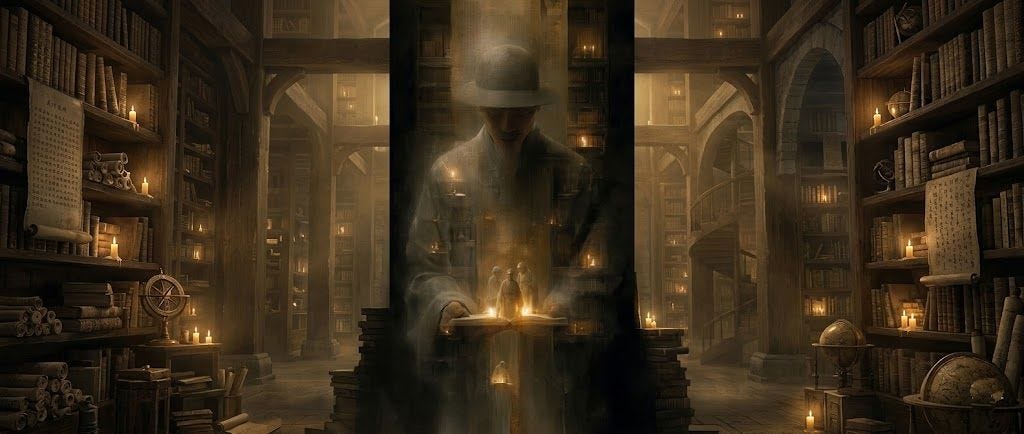
In Post 7, we looked at the structural parallel between the Antikythera Mechanism—thirty bronze gears predicting eclipses decades in advance, unmatched for fourteen hundred years—and modern AI: the same knowledge encapsulation, the same user/maker asymmetry, the same vocabulary degrading as it spreads outward from the people who built the thing. This post goes one level deeper, to the specific people who hold complex knowledge traditions together—and what happens when they are gone.
The People the Archive Misses
Every knowledge tradition that reaches genuine complexity generates a keeper class. Not the users of the knowledge, not the scholars who write about it—but the people whose specific function is to hold the knowledge, transmit it, and maintain the conditions under which transmission is possible.
The keeper class is not always visible. It is not always prestigious. Its members are sometimes quite deliberately kept out of the official record, because the value of specialized knowledge depends partly on it remaining specialized. But in every case where complex knowledge has survived across generations, a keeper class was there—passing something forward, hand to hand, body to body, year after year.
Three examples. You have met all three before in this series—in Post 4, they illustrated what technological loss looks like: the products survive, the process doesn’t. That argument was about what gets lost. This post returns to the same three cases to ask a different question: how the knowledge was held in the first place, and what specific mechanism kept it alive across generations. The answer is the same in all three cases, and naming it changes what the AI section that follows actually means.
The Scribes Who Watched the Sky
The tupšar Enūma Anu Enlil were hereditary priestly scribes in the temple institutions of Babylon, Uruk, and Nippur. For five centuries—from roughly 747 BCE onward—they maintained a continuous record of the night sky. Every night, what was observed was recorded in cuneiform on clay tablets. Planetary positions, lunar phases, eclipse timings, weather, floods, market prices. All of it logged, dated, and stored.
Their knowledge was not secret in the way that a conspiracy is secret. It was operationally restricted in a practical sense: only people trained from childhood within the tradition could actually use it. It took years to learn to read the tablets, years more to understand the predictive procedures they encoded, and years more still to apply those procedures with enough precision to be useful. The knowledge lived inside a long training process. It could not be extracted from that process and handed to an outsider in a useful form.
That training process was the mechanism’s real engine. The five centuries of records were the raw material. The transmission of how to read and use those records—from one generation of scribes to the next—was what made the raw material valuable.
The Antikythera Mechanism’s eclipse predictions are built on that five-century record. Every gear ratio encoding a lunar cycle represents accumulated knowledge that passed through dozens of generations of that training chain before it reached the maker’s hands.
The Violin Makers of Cremona
Between roughly 1680 and 1720, the workshops of Cremona produced a set of stringed instruments that have never been fully explained. Antonio Stradivari alone built over a thousand. Around 650 survive. Three hundred years of intensive effort—chemical analysis, acoustic modeling, CT scanning, wood sourcing—has not resolved what made them.
Blind listening tests conducted since 2012 have complicated the picture: studies published in the Proceedings of the National Academy of Sciences found that experienced players under controlled conditions could not reliably distinguish Stradivari from high-quality modern instruments, and listeners in some tests preferred the new. Whether the instruments have been acoustically surpassed is, at this point, a genuinely open question.
What has not been replicated is the process—the specific combination of material selection, geometry, varnish chemistry, and accumulated workshop judgment that produced them. The instruments remain. The knowledge that made them does not.
The Cremonese makers were a keeper class organized around family workshops concentrated in a single city. The knowledge was not written down. Writing it down was not how it worked. It worked through the hand, the eye, and the ear of someone who had made enough instruments to know what good sounded like before it was finished—who could look at a piece of Alpine spruce, tap it, flex it, and know whether it would do what the finished instrument needed.
That judgment could not be acquired by reading. It could only be acquired by doing, under correction, repeatedly, over years, beside someone who already had it. When Stradivari died in 1737, at roughly ninety-three years old, that judgment died with him.
The Navigators Who Felt the Ocean
The wayfinders of the Pacific Islands guided the settlement of the largest ocean on earth. Without instruments, without charts, they found landfall across thousands of miles of open water—using stellar positions, the direction of deep ocean swells beneath surface chop, the behavior of birds and fish, the color of water, the shape of clouds over distant islands.
This was not intuition. It was a precise, hard-won body of knowledge, built up over centuries and encoded partly in chants, partly in physical models made of sticks and shells, and above all in the body of the navigator—in a somatic sensitivity that could only be developed by spending enough time at sea, under the correction of someone who had more of it.
The transmission system required the student to live with the master, sail with the master, and gradually take over navigational decisions under the master’s watchful correction. The knowledge transferred, piece by piece, year by year, until the master’s knowledge lived in the student’s body.
In the communities where colonialism ended that chain—dispersing the masters, preventing the apprenticeships, making the tradition seem backward or unnecessary—the knowledge simply stopped being passed on. No dramatic burning. No moment of catastrophe. Just a generation without masters to learn from, followed by a generation that had never seen it done.
What All Three Had in Common: Apprenticeship
The tupšar scribes, the Cremonese violin makers, the Pacific navigators. Three different cultures, three different bodies of knowledge, three different centuries. But one transmission mechanism underlying all three.
Apprenticeship.
Not in the vague sense of “learning from someone more experienced”—but in the precise sense of a structured, prolonged, corrected transmission of knowledge from one body to another. The student works beside the master. The master corrects. The student internalizes not just the technique but the standard—the felt sense of what good work is, recognized before it is finished, not derived from a rule but from accumulated exposure to enough examples under enough correction that the judgment becomes second nature.
Apprenticeship is the crank of embodied knowledge transmission. It is the specific mechanism by which the standard moves from one generation to the next. And it is fragile in a specific way: it requires time, proximity, institutional stability, and a master who has not yet left.
The codex—the written record—can survive institutional disruption. A tablet can be buried and dug up. A text can be copied in a different city by a different scholar. The apprenticeship chain cannot be buried and dug up. When it breaks, what is lost is the living standard that the written record was pointing at. The description survives. The thing being described does not.
This is why the series has been saying, since Post 3, that ideas outlast techniques and techniques outlast standards. The standard—the operational sense of what good work actually is—lives in the apprenticeship chain. Break the chain, and the standard begins its slow, invisible drift toward approximation.
The Longteam
There is a word for what the tupšar scribes, the Cremonese violin makers, and the Pacific navigators all were. It does not have a common name in English, so one is needed here.
Call it the longteam.
A team operates in the same moment—coordinated, contemporary, working side by side. A longteam operates across time. It is a transmission lineage treated as a single continuous entity: each generation receiving what was built before them, holding it for their working lifetime, and passing it forward to the next. The obligation runs in both directions—backward in gratitude to those who built what you received, forward in duty to those who will need what you carry.
The tupšar scribes were a longteam. The five centuries of sky records they maintained were not the work of one generation. They were the accumulated output of a single continuous enterprise, each generation adding to what the last had built, each one knowing that the value of their work depended on the work of everyone who came before and everyone who would come after.
The Cremonese makers were a longteam. The acoustic knowledge that produced a Stradivarius was not invented by Stradivari. It was accumulated across generations of Cremonese workshops, each refining what the last had passed down. Stradivari was the apex of a longteam, not its sole author.
The Pacific navigators were a longteam until colonialism convinced—or forced—their members to resign from it.
The longteam is not merely a useful metaphor. It is the specific social structure that allows embodied knowledge to survive across timescales longer than any individual life. You cannot hold five centuries of sky observation in one body. You can hold it in a longteam. The chain is the container.
The Invisible Keeper Problem
Keeper classes are systematically missing from the historical record—and the reason is structural, not accidental.
Textual knowledge generates texts. Texts are what archives preserve. Embodied knowledge generates practitioners. Practitioners are what archives miss.
We know the names of the Greek mathematical astronomers—Hipparchus, Eratosthenes, Ptolemy—because they wrote, and their writing was copied. We do not know the names of the bronze-workers who cut the mechanism’s gears to tolerances unmatched for fourteen hundred years, because they did not write, and their knowledge generated no textual record. We know the names of the Babylonian scribal families from administrative documents. We do not know the names of the craftsmen who built the instruments those scribes used to observe the sky.
This invisibility tracks along social status lines. In most societies, throughout most of history, the keeper classes of embodied knowledge ranked below the keeper classes of textual knowledge. Craftsmen below scholars. Navigators below priests. The social invisibility of the embodied keeper and the archival invisibility of the knowledge they held are the same phenomenon.
When that knowledge is lost, the loss is doubly invisible. The keepers were not recorded while they lived. The knowledge left no textual trace when they died. The historical record shows a gap—but not what filled the gap, because what filled the gap was never in the record to begin with.
The Antikythera Mechanism is a rare exception. We do not know the names of the people who made it. But the mechanism is their knowledge, physically preserved at the bottom of the sea in a form that modern technology can partially read. It is a keeper that outlasted its keepers. The gears hold what the craftsmen’s hands knew. We can read the gears. We cannot read the craftsmen.
The AI Keeper Class—and the Apprenticeship Problem
The current AI knowledge tradition has a keeper class that is, by historical standards, unusually visible. The researchers who developed the transformer architecture, the training procedures, the scaling laws, and the alignment techniques underlying current frontier models are named people at named institutions. Their papers are public. Their contributions are documented.
This visibility is real. It is also misleading about the depth of the keeper problem—because the visible keeper class is only the textual layer of the tradition.
Below it is an embodied layer that is less visible and far more fragile: the engineers who know, from operational experience, how training runs actually behave when something goes wrong; the infrastructure specialists who know why specific hardware configurations produce specific failure modes; the data curators who know what is actually in the training sets and how it shaped the outputs; the evaluators who have developed, through practice, a calibrated sense of what model behavior actually means—not from the papers, but from having seen enough of it.
That embodied knowledge is not in the papers. It is in the people. And the apprenticeship conditions required to pass it forward are not being maintained.
The turnover rate in AI research is high. Senior researchers move between companies, start new ventures, leave the field. When they leave, the institution retains the published record of their work—the codex. What leaves with them is the operational judgment that made the work productive. The junior researchers who worked beside them absorbed some of that judgment through proximity and correction. When the senior researcher leaves before the transmission is complete, the apprenticeship chain is broken mid-cycle.
This is not an HR problem. It is an apprenticeship problem. The published record is the codex. The apprenticeship is what kept it honest. When the apprenticeship chain breaks, the codex becomes the sole authority—and the codex, as the series has argued since Post 3, cannot fully encode the standard it was developed to describe.
The Extraction Problem
Every previous technology that drew on a longteam’s output left the longteam itself intact.
The printing press spread the output of scribal traditions across Europe without destroying the scribes. The phonograph spread the output of musical traditions without ending the transmission chains that produced the musicians. Industrial manufacturing drew on craft knowledge without immediately eliminating the craft workshops—at least not all of them, not immediately.
AI is the first technology whose output is so complete, so accessible, and so cheap that it removes the incentive to join the longteam in the first place.
Why apprentice for a decade under a master navigator when you can query the accumulated output of all navigators? Why spend years developing calibrated judgment about model behavior when a system trained on the output of everyone who has done that work will answer your question in seconds?
The answer—the answer the series has been building toward since Post 1—is that the query returns the codex, not the standard. It returns the description of what good judgment looks like, not the judgment itself. It returns the map, not the territory.
But the map is very good. And the map is instant. And the apprenticeship is slow, expensive, and requires a master who has not yet left.
So the longteam dissolves. Not by conquest, as Rome dismantled the Hellenistic knowledge network. Not by burning, as the Maya codices were burned. Not by dispossession, as colonialism ended the Pacific navigation traditions. By being made to feel unnecessary.
The mechanism’s users turned the crank and got the answers. The knowledge of how to make the crank and the gears stayed in the workshop on Rhodes. When the workshops were gone and the last maker had died, the answers kept coming—until the device wore out, and there was nobody left who knew how to make another one.
The series has been describing that moment for eight posts. The question Post 9 turns to is: what happens after. When the gap has opened—what does recovery actually require, and when is it possible?
Next: Recovery—the Dead Sea Scrolls, the Herculaneum papyri, Roman concrete reconstructed from harbor cores. When lost knowledge can come back, when it cannot, and what the Antikythera Mechanism itself tells us about the conditions that make recovery possible at all.
References
Freeth, T., Bitsakis, Y., Moussas, X., et al. (2006). “Decoding the ancient Greek astronomical calculator known as the Antikythera Mechanism.” Nature, 444, 587–591. https://doi.org/10.1038/nature05357
Rochberg, F. (2004). The Heavenly Writing: Divination, Horoscopy, and Astronomy in Mesopotamian Culture. Cambridge University Press.
Fritz, C., Curtin, J., Poitevineau, J., Morrel-Samuels, P., & Tao, F-C. (2012). “Player preferences among new and old violins.” Proceedings of the National Academy of Sciences, 109(3), 760–763. https://doi.org/10.1073/pnas.1114999109
Fritz, C., Curtin, J., Poitevineau, J., & Tao, F-C. (2014). “Soloist evaluations of six Old Italian and six new violins.” Proceedings of the National Academy of Sciences, 111(20), 7224–7229. https://doi.org/10.1073/pnas.1323367111
Lewis, D. (1972). We, the Navigators: The Ancient Art of Landfinding in the Pacific. University of Hawaii Press.
Vaswani, A., Shazeer, N., Parmar, N., et al. (2017). “Attention Is All You Need.” Advances in Neural Information Processing Systems, 30. https://arxiv.org/abs/1706.03762
#3. The worry I hear most is that AI 'IS' the longstream: teaching it's 'Self' - artisans and craftsmen. And that there is NO human in charge. Wouldn't that be awful?!?!?
#2. Let's have a look at Congress (elected politicians) as a 'longstream?' There certainly is a NEED. :-)