Recovery
THE GEARS OF LOST KNOWLEDGE — Post 9 of 10 by pazooter

Estimated read time: 6 minutes
In Post 8, we met the keeper class—the tupšar scribes of Babylon, the violin makers of Cremona, the wayfinders of the Pacific—and traced the specific ways that embodied knowledge dies when its carriers are gone. We also named the threat to the AI keeper class: not destruction, but something quieter. The longteam dissolves when it’s made to feel unnecessary. This post asks what comes after the gap opens. When knowledge is lost, what does recovery actually look like? And when is it even possible?
The Machine Is the Recovery
Here is something worth sitting with before we go any further.
The Antikythera Mechanism—the corroded bronze box pulled from a shipwreck off a small Greek island in 1901, with its thirty bronze gears cut to tolerances not matched again for fourteen hundred years—is not just the subject of this series. It is a recovery. It is the thing that came back.
The mathematics behind it were never entirely lost. The Babylonian astronomical tables, the Greek geometric methods, the eclipse-prediction cycles—fragments of all of these survived in copied texts. What was lost was the craft knowledge: the ability to cut gears to those tolerances, to design a mechanism that compensated for the lunar anomaly, to hold the whole synthesis together in bronze and make it work. No text preserved that. The texts described what the device could do. They could not describe how to do it.
The mechanism came back because the mechanism itself survived—at the bottom of the sea, out of reach of the Roman collecting apparatus that dispersed nearly everything else it touched. The loss of the ship was the condition of the mechanism’s survival. The catastrophe that destroyed its delivery preserved its knowledge.
That is the shape of recovery. And it is worth understanding clearly, because it is not the shape most people imagine.
When Recovery Is Possible
Recovery tends to follow a specific pattern. It is possible under two conditions, and impossible under a third.
The first condition: the written record survives.
The reconstruction of Babylonian astronomical knowledge in the 19th and 20th centuries was possible because enough cuneiform tablets survived in Mesopotamian archaeological sites to reconstruct the predictive procedures, the vocabulary, and the observational database. The tablets were there. They required decipherment—which took most of the 19th century—but the information was recoverable.
There is a limit to this kind of recovery, though, and it is important to name it. The tablets are a codex without a living practice behind them. Modern scholars can read the terms—trace their etymology, map their usage, reconstruct their grammar—but cannot fully recover their operational content. The written lexicon survived. The living lexicon that kept it honest did not. What comes back from the written record alone is the description of the standard, not the standard itself.
The second condition: the physical artifact survives.
The reconstruction of Roman hydraulic concrete—its properties fully characterized only in the 21st century—was possible because Roman harbor structures survived in sufficient quantity and condition to allow materials analysis. Modern analytical chemistry could read the composition of the concrete directly from the ancient harbors. The physical object held operational knowledge the textual record had lost. No Roman engineering manual told researchers what to look for. The stone told them.
This is a different kind of recovery from the first. It does not depend on what was written down. It depends on what was built, and on whether enough of what was built survived intact, and on whether the analytical tools exist to read it.
When Recovery Is Not Possible
Greek fire is the clearest example of a loss with no path back.
The textual record establishes that it existed. It describes the effects: a burning liquid that could not be extinguished by water, that could be projected through siphons, that could burn on the surface of the sea. It provides fragmentary accounts of the composition. What it does not preserve—what no surviving source preserves—is the operational knowledge required to reproduce it. There is no surviving physical artifact, no intact sample, no archaeological trace of its production.
Reconstruction is possible in the sense of producing something with some of the described properties. It is not possible in the sense of confirming that what is reproduced is what was lost. The gap is real, and it is permanent.
The Stradivari problem sits in the middle. The instruments survive. Modern analysis can characterize their acoustic properties and their material composition with high precision. What cannot be recovered is the maker’s judgment—the specific decisions made in the course of construction that produced the combination of material and geometry that generates the acoustic result. The artifacts survived. The embodied knowledge that produced them did not.
You can hold a Stradivarius. You can measure it to the millimeter. You can analyze the varnish. You can model the acoustics. And at the end of all of that, the instrument will not tell you what the maker’s hands knew that yours do not.
The Role of Lucky Accidents
Some recoveries happened because someone made a deliberate preservation decision that worked beyond all reasonable expectation.
The Dead Sea Scrolls—discovered by a Bedouin shepherd in 1947—preserved textual records of Second Temple Judaism that had been absent from the world for two millennia. The community at Qumran—identified by most scholars as Essene, though the attribution remains a working hypothesis rather than settled fact—placed them in clay jars in caves in the Judean desert with intent: they were acting as keepers, making deliberate choices about material and location. What no one could have planned was the two-thousand-year chain of non-discovery that followed, or the specific shepherd who broke it in 1947. The preservation act was intentional. The survival was not. Those are different things, and the distinction matters: it means that deliberate preservation can work across timescales that make planning impossible—if the materials are right and the conditions hold.
Other recoveries had no deliberate act behind them at all. They were triggered by the survival of an artifact that no one chose to save—a physical keeper that outlasted every human keeper through pure accident of circumstance.
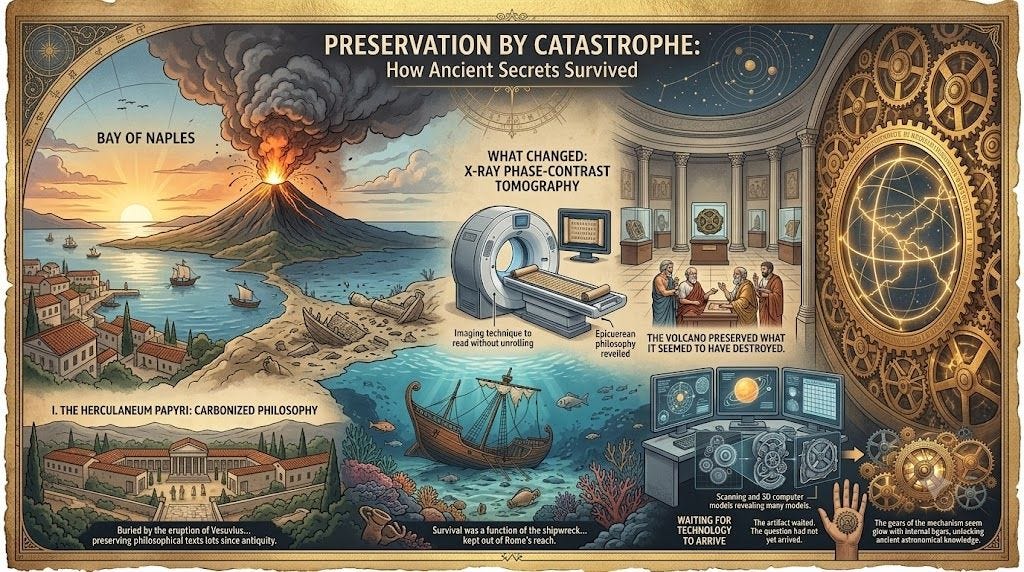
The Herculaneum papyri are the clearest example. Buried by the eruption of Vesuvius in 79 CE, they preserve philosophical texts that survived nowhere else—including works of Epicurean philosophy lost since antiquity. For centuries, the scrolls could not be read: they were carbonized by the eruption and disintegrated when touched. Recovery began as a lucky accident of preservation. Then it stalled for lack of technology.
What changed was X-ray phase-contrast tomography—an imaging technique that allows researchers to read the text of the carbonized scrolls without unrolling them. A lucky preservation event, combined with a technology the preservation could not have anticipated, is producing recoveries that were impossible a decade ago. The volcano preserved what the volcano seemed to have destroyed.
The mechanism is the same story. Its survival was a function of the shipwreck—a catastrophe that kept it out of Rome’s reach and at the bottom of the sea. It sat in the National Archaeological Museum in Athens for a year after the salvage before anyone noticed the gear wheel inside one of the corroded fragments. It sat for decades more before the imaging technology existed to read the inscriptions on the interior. The artifact waited. The question had not yet arrived.
The Question
This is the condition the lucky accidents reveal—and it is the one most easily overlooked.
Recovery requires not just the artifact and the technology. It requires the question. And the question requires a community that knows enough about what was lost to know what to look for.
When the technology finally existed to read the mechanism’s interior inscriptions, there was a community of scholars—historians of science, archaeologists, mechanical engineers, classicists—capable of asking the right questions of what the technology revealed. That community did not appear from nowhere. It was the product of a long tradition of scholarship, itself a kind of longteam, holding enough knowledge about the ancient world to recognize what they were looking at when the gears came into focus.
If that community had not existed—if the chain of scholarship had broken earlier, if the right questions had not been developed and transmitted—the mechanism would still be sitting in the museum, incomprehensible. The artifact would be there. The recovery would not.
We cannot plan for lucky accidents. The scrolls that survive are not the ones we choose. The shipwrecks that preserve what we need are not the ones we arrange. What we can do is maintain the community of practitioners capable of reading the evidence when it surfaces.
The question must exist before the artifact is found. Recovery is a community problem, not a technology problem.
Next: The Question and the Crank—who the tradition is serving, what happens when that changes, and the AI vocabulary degrading in real time through exactly the translation pattern from Post 3. The final turn of the screw.
References
Freeth, T., Bitsakis, Y., Moussas, X., et al. (2006). “Decoding the ancient Greek astronomical calculator known as the Antikythera Mechanism.” Nature, 444, 587–591. https://doi.org/10.1038/nature05357
Jackson, M.D., Mulcahy, S.R., Chen, H., et al. (2017). “Unlocking the secrets of Al-tobermorite in Roman seawater concrete.” American Mineralogist, 102(7–8), 1435–1450. https://doi.org/10.2138/am-2017-5993CC
Masic, A., Seymour, L.M., Maragh, J., et al. (2023). “Hot mixing: Mechanistic insights into the durability of ancient Roman concrete.” Science Advances, 9(1). https://doi.org/10.1126/sciadv.add1602
VanderKam, J.C. (2010). The Dead Sea Scrolls Today. 2nd ed. Eerdmans.
Mocella, V., Brun, E., Ferrero, C., et al. (2015). “Revealing letters in rolled Herculaneum papyri by X-ray phase-contrast imaging.” Nature Communications, 6, 5895. https://doi.org/10.1038/ncomms6895
Looking forward to your 'Question.' Mine today is "Why is it so difficult for so many to miss, i.e., not see, the 'need' for the longstream: Knowledge? XOXO