How Knowledge Is Lost
THE GEARS OF LOST KNOWLEDGE — Supplement II by pazooter

Estimated read time: 12 minutes
This post follows the ten-part series “The Gears of Lost Knowledge” and the supplement “How the Gears Disappear.” It draws on cases documented across Posts 1–10. Readers arriving here first will find Post 1—The Machine Inside Out is the place to start.
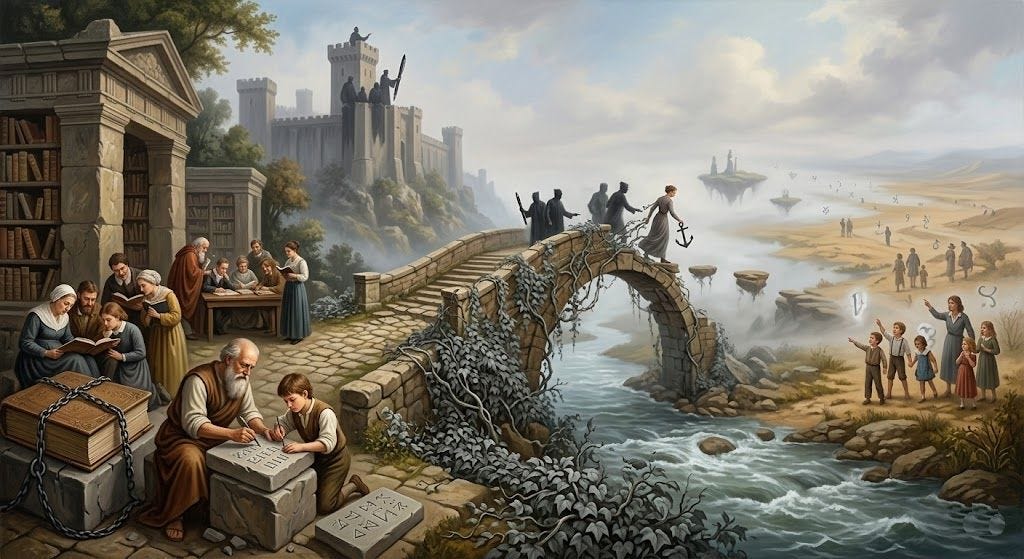
Antonio Stradivari had apprentices. He didn’t work alone or die without successors. The workshops of Cremona continued after him. His sons continued. The tradition continued.
And yet no instrument built after 1737 has matched his.
So here is the question the series never quite asked directly: when Stradivari stopped an apprentice mid-work and said no—this must be done in a way that appreciates— what came next? What was the word at the end of that sentence? Had that word been coined yet? If it had been coined, had it been written down? If it had been written down, did the apprentice’s apprentice understand it the way Stradivari understood it—or did they understand a version of it, a shallower version, a version calibrated not against fifty years of finished instruments but against a description of what fifty years of finished instruments was supposed to have taught?
There is a possibility more unsettling than any of those. The word at the end of Stradivari’s sentence may never have existed. His practice may have outrun the vocabulary available to name it. The refinements he had accumulated over fifty years may have been operating at a precision the tradition’s language could not yet reach—which meant there was no symbol to transmit, no term to write down, no word for the apprentice to misunderstand or fail to look up. The knowledge lived entirely in his hands, and when his hands stopped, it stopped.
Perfection, in this reading, does not preserve a tradition. It can kill the transmission chain.
That is one stage in a process the ten-part series documented across dozens of cases without ever naming as a unified arc. Every case of lost knowledge in the series is an instance of the same devolution—a symbol moving away from what it was coined to name, by predictable stages, until the gap between word and referent (the original concept) becomes too wide to bridge: the “misunderstood word.”
The Devolution Arc
Words are basically symbols; they stand for something—an object, an action, a description. But a word is not the thing it stands for. Symbols begin precise. A practitioner encounters something real—a configuration of stars, a behavior of molten metal, a quality of tone in a piece of wood—that matters enough to name. The name they coin is calibrated exactly against that thing. It is operational: to use the term correctly, you have to have done what it describes. The word and the practice are in continuous contact.
This contact—vocabulary held in living correspondence with its origin—is what might be called the etymotic lexicon (from etymon: the original, true sense of a word). The etymotic lexicon is not merely vocabulary in use. It is vocabulary being actively kept honest by practitioners who can demonstrate what the word points at and correct you when you use it wrongly. When the etymotic lexicon holds, knowledge transmits. When it breaks, the devolution begins.
From the origin point, the devolution proceeds by the following stages—not always in sequence, sometimes skipping, sometimes compounding. Without active resistance, the direction is consistent. With it, the arc can be slowed, interrupted, or even somewhat reversed—but the effort required increases with every stage allowed to pass.
The etymotic (original) symbol is transmitted through apprenticeship. The practitioner corrects the student. The correction is what keeps the student’s relationship to the symbol honest—it calibrates their use of the term against the actual referent. As long as the correction is available from someone who has done the thing the word describes, the word holds.
The symbol is recorded. Committed to writing, the symbol survives the practitioner. But a written definition describes the referent; it cannot correct the reader’s use of the term. A reader who has never done the thing the word describes acquires a starting point, a reasonable approximation—but not the calibration. This is the first step away from the etymotic.
The symbol crosses a language boundary. Translation is transmission by a non-practitioner. The translator assigns the closest available term in the receiving language—shaped by that language’s existing categories and prior referents. What fits neatly into the receiving vocabulary survives the crossing. What has no equivalent is dropped, distorted, or collapsed into something adjacent. The gap opens invisibly, because the translated term appears complete. The receiver has no way to know what was filtered out.
The symbol is inherited without practice. The written record survives but the apprenticeship chain breaks. The symbol is now entirely dependent on the text for its meaning—no correction available, no practitioner to calibrate against. The next inheritor uses the word as they understood it from reading, not from doing. The one after them inherits that use. With each transmission cycle, the symbol tends to move one step further from its origin—not because anyone used it carelessly, but because the standard it was coined to name is no longer available to correct against. The symbol now points at a description of the referent rather than the referent itself.
The user drifts from the symbol’s origin. Given enough transmission cycles without calibration, the connection between the user and the symbol’s original referent becomes nominal. The symbol itself hasn’t changed—it still appears in texts, gets used in sentences, passes forward—but what the user understands it to point at has shifted so far from its origin that they will produce an inexact result, never knowing why. Someone building on that understanding might produce something adjacent to what they intended. Again, never knowing why.
The user is deliberately distanced from the symbol’s origin. At this stage the drift is not a consequence of broken transmission—it is the objective. A user who cannot close the gap between themselves and a symbol’s origin cannot think clearly with that symbol. They can only react to it. Confusion is the predictable result of sufficient distance from meaning—and a confused person is more dependent on authority to interpret the world for them. Someone, in every generation, has understood that. The deliberate production of users who approximate rather than verify is not just bad pedagogy. It is the systematic manufacture of a population that cannot own the words it uses—and a population that cannot own its words can become slaves to the special interests of others.
The road back is blocked. The corrective knowledge exists—the etymotic content can still be found, the standard can still be demonstrated—but the institutional road to it has been closed. The closing takes different forms: the burning of books and the destruction of the communities that could read them; the capture of credentialing bodies by organizations whose revenue depends on the wrong methodology; the suppression of research by industries whose liability depends on the findings not reaching the public; the removal from curricula of histories that would correct the dominant account. What these have in common is not the absence of the correction but the deliberate closing of access to it. The gap is not inherited. It is enforced. And because the enforcement is institutional rather than individual, it persists past the death of anyone who chose it—self-maintaining, structurally invisible, and indistinguishable from the outside from simple ignorance.
A variant that can occur at any stage: The practice outruns the vocabulary. The apex practitioner reaches a refinement the tradition’s existing language cannot name. No symbol is coined. When the practitioner dies, that level of the knowledge dies with them—not because the transmission chain broke, but because the chain never had a link at that level of precision. What the next generation inherits is the standard below the apex: the only standard the etymotic lexicon could hold. Stradivari is the clearest case in the series. Perfection does not guarantee transmission. It can end it.
Every case the series documented falls somewhere on this arc.
From Procedure to Chant
Post 3 opened with the clearest single example of translation loss: AN.MI.
In the Babylonian astronomical tradition, AN.MI named a specific configuration within the Saros cycle—an 18-year repeating pattern of eclipses. It was operational: a practitioner who used it correctly had been trained to recognize the configuration, predict its recurrence, and respond to its political and geographic consequences. The symbol carried all of that. It was a procedure encoded in a term—the etymotic lexicon at its most precise.
When Greek translators absorbed Babylonian astronomical knowledge, they rendered AN.MI as ekleipsis—disappearance. The visual phenomenon crossed the language boundary. The procedure did not. The Babylonian calibration—actual sky observation, actual prediction cycles, actual consequences—was filtered out at stage three, because the receiving vocabulary had no category for it. The Greek scholar who learned ekleipsis learned it from a text. The text described what AN.MI had done. It could not describe what knowing AN.MI had felt like to use.
The Antikythera Mechanism—thirty bronze gears encoding the full Saros arithmetic—preserves Babylonian procedures in its mechanics while its Greek inscriptions describe something shallower. The surface language and the operational substrate were already from two different points on the devolution arc, existing simultaneously in the same object: the translation recent enough that the gears could still be built, old enough that the inscriptions could no longer fully name what the gears were doing.
Copernicus, working fifteen centuries later, was still doing vocabulary archaeology—tracing terms back through their Latin, Arabic, and Syriac transmission cycles, trying to recover what they had originally pointed at before each crossing had filtered out another layer of operational content. He was at stage five, trying to reconstruct a stage-one meaning from what remained.
The endpoint of this arc—the word that has traveled so far from its origin that it no longer requires understanding, only repetition—is the chant. A chant is a symbol that has completed its devolution: the etymotic content is entirely gone, and what remains is pure sound that produces a state in the user rather than a thought. AN.MI was a procedure. Ekleipsis was a label. The word for eclipse in the mouth of someone who has never looked at the sky is a chant.
Greek Fire: The Symbol Never Written
The formula for Greek fire never reached stage two. By deliberate policy it was never committed to writing.
Emperor Constantine VII documented the policy explicitly: three things must never reach foreign hands—the imperial regalia, a royal princess, and the formula. For seven centuries the knowledge was transmitted within a single family of engineers in Constantinople, mouth to ear, hand to hand. The production vocabulary—whatever terms named the right viscosity, the correct temperature, the visual cue that the preparation was ready—existed only in speech and in practice. The etymotic lexicon was deliberately kept off the page.
What survives in the historical record are descriptions of effects. Byzantine sources like Anna Komnene’s Alexiad describe what Greek fire did: it burned on water, resisted conventional extinguishing, was projected through bronze tubes at enemy ships. This is effect-vocabulary—words that name what the substance did—with no surviving production-vocabulary to name what done looked and felt like to the person making it.
When Constantinople fell in 1453 and the family ended with it, the transmission chain ended at stage one. Modern chemistry has produced reconstructions—petroleum-based, with quicklime, sulfur, possibly resins. None has been confirmed to match the performance the sources describe, because there is no recorded symbol to work backward from. The word that would have anchored the search was never written down.
Roman Concrete: The Symbol Without Its Standard
Pliny the Elder wrote about Roman hydraulic concrete in his Naturalis Historia around 79 CE. He named the key ingredient: pulvis puteolanus—the volcanic ash from Pozzuoli, later called pozzolana. He described the result: harbor structures that became “a single stone mass, impregnable to the waves and every day stronger.”
The word survived. Medieval builders knew it. Pozzolana was in the vocabulary—readable in Pliny, available in texts, applicable in sentences. This is stage four’s most deceptive quality: the symbol persists after its standard is gone, and is indistinguishable from the inside from a symbol still in contact with its origin. The etymotic lexicon had broken. Nothing visible marked the break.
What Pliny could not transmit through a written description was the operational standard—the specific ratios, the correct seawater temperature, the behavior of the mixture during curing that told an experienced hand whether the batch would hold. That knowledge had lived in the Roman guild system. When the Western Empire dissolved and the guilds with it, medieval builders inherited pozzolana as a label for a substance rather than a term of art for a procedure. The symbol was right. What the symbol was pointing at was gone.
The formula was reconstructed in the 21st century—not from any surviving text, but from materials analysis of Roman harbor structures still standing in the Mediterranean. The stone had held the operational knowledge that the vocabulary had lost.
Damascus Steel: The Symbol Never Coined
The surface pattern on a blade of Damascus steel—the watered-silk flow of light and dark across the metal—was called firind in Arabic, jauhar in Persian. Both terms named the visible result. Neither named the process.
This is the variant in operation: no symbol coined for the thing that mattered most. The smiths who produced Damascus steel from wootz ingots understood their craft empirically and transmitted it through apprenticeship. Whatever they called the moment when the steel was right—if they had a term for the color of the metal at the correct forging temperature, for the resistance of the hammer at the correct stage, for the visual cue that the carbide structure was forming—that vocabulary, if it ever existed as explicit terms, died in the workshops.
Research published in Nature in 2006 identified carbon nanotubes and cementite nanowires in a 17th-century Damascus sabre—a nanostructure the medieval smiths had produced without knowing it, through a process they understood only as felt practice. The structure was found. Reproducing it consistently remains unsolved, because there is no symbol to work backward from. You cannot recover the etymotic lexicon of a word that was never coined.
Alexandria: The Symbol Without a Community
The Library of Alexandria is the most famous knowledge loss in history, and the most misunderstood. The popular version—one fire, everything gone—is wrong. The library declined across three centuries of institutional exhaustion. Many scrolls were copied elsewhere. The texts survived, in fragments.
What did not survive was the community of scholars whose ongoing work kept the vocabulary calibrated—the etymotic lexicon’s human infrastructure. As the institution died—funding cut, staff scattered—the scrolls passed from stage two toward stage five without the correction mechanism that stage one requires. The written record existed. The living standard it had been developed against did not.
A scroll of Babylonian astronomical procedures requires a reader who knows not just the language but the technical vocabulary inside the language: terms that look like ordinary words but carry operational content that only practice calibrates. Later readers could use those words in sentences. They could not always recover what the words had been coined to do. The devolution had proceeded far enough that the symbol was present on the page while pointing at something too degraded to support the original procedure.
The Maya Codices: The Symbol Burned Twice
On July 12, 1562, Bishop Diego de Landa burned the Maya codices at Maní—at least 27 books containing centuries of astronomical, calendrical, and ritual knowledge encoded in Maya hieroglyphic script.
That burning is the event history records. It was not where the knowledge died.
The Maya priestly class who could read those codices with full operational understanding had been under systematic destruction for decades before de Landa arrived. Conversion, displacement, execution, and deliberate suppression had been severing the apprenticeship chains through which the etymotic lexicon was maintained. The community whose corrections kept the symbols calibrated was being dismantled generation by generation. The written record was becoming inaccessible before a single page was burned—because the practitioners who could hold the gap between symbol and referent closed were already gone, or going.
De Landa burned the books. The etymotic lexicon had already been burning for years.
His reasoning was documented. The codices preserved knowledge he found personally threatening—not strategically threatening, in the way a weapon is threatening, but threatening in the way evidence is threatening. The knowledge in those books named a civilization whose sophistication contradicted the account of himself and his mission he required. The symbols had to be moved past their point of recovery.
That is stage six operating through stage seven: the user deliberately distanced from meaning, and then the road back closed.
What the Series Was Showing
Every case documented across Posts 1–10 follows the same arc. The events differ. What they all do is move the user further from the symbol’s etymotic origin—breaking the contact between the word and the practice that kept it honest, by whatever means were available.
The symbol survives. The texts survive. The inscriptions survive. The buildings survive. The instruments survive. What does not survive is the calibration—the standard the symbol was developed to name, maintained by the correction of a practitioner who knew the difference between using a word correctly and using it approximately.
The apprentice’s apprentice inherits the term. They use it in sentences. They pass it forward. What they cannot pass forward is what they did not receive: the etymotic content of the word, which can only be held by someone who has done the thing it describes and been corrected by someone who did it better.
This is not a failure of memory or intelligence. It is the predictable outcome of a user moving away from a symbol’s etymotic origin—by any of the stages described above, in any combination, over any number of transmission cycles.
When the Loss Is Closer to Home
Civilization recognized this problem and built a tool to address it: the dictionary.
A dictionary is not merely a list of words. It is an attempt to arrest the devolution arc at stage two—to capture the calibrated meaning of a symbol in writing precise enough that a reader without access to a living practitioner can still recover something close to what the word was coined to point at. It is the institutional substitute for the correction that apprenticeship provided: a written proxy for the etymotic lexicon, available to anyone who uses it.
For most of American educational history, students were taught to use it. When a word was not understood, the instruction was to stop and look it up—to verify the meaning against a recorded standard rather than approximate it from surrounding context. That habit, consistently practiced, produces a specific capacity: the ability to identify the point at which a symbol’s meaning is uncertain and resolve the uncertainty before building on top of it.
Beginning in the mid-20th century, a pedagogical movement called Whole Language began systematically replacing that habit. Its central premise was that children learn language naturally, through immersion rather than explicit instruction. In practice this meant replacing dictionary verification with context-guessing: when a word is not understood, infer its meaning from the surrounding sentence. Keep reading. Do not stop.
The instruction being institutionalized was precisely: do not arrest the devolution. Pass the unresolved symbol forward and keep going.
The movement was organized, well-funded, and widely adopted. By the 1980s and 1990s it had become the conventional wisdom in American reading education. Later rebranded as Balanced Literacy, it persisted in schools for decades after the research had turned decisively against it. Studies found that students taught to guess from context were less accurate than students taught to decode precisely. Vocabulary scores began a measurable national decline after 2009 that has continued since. One literacy researcher, writing in 2020, noted simply: “Dictionary instruction appears to be a lost art.”
What kept the wrong methodology in place was not inertia alone. To teach in an American public school, a teacher must hold a certificate issued by a state-approved preparation program. Those programs are accredited by a body called CAEP—the Council for the Accreditation of Educator Preparation—which defers its literacy standards to professional organizations, chiefly NCTE, the National Council of Teachers of English. NCTE is the same organization that championed context-based reading methodology for fifty years. Its leadership built careers on it. Its journals published it. Its conferences promoted it.
That organization still holds the pen on what an approved literacy teacher preparation program looks like. State legislation mandating better reading instruction touches the output—the classroom. It does not touch the road that made the teacher. That road runs from NCTE through CAEP into every education school that wants its programs recognized.
A student whose teacher was never taught to model genuine word inquiry—stopping, looking it up, owning the meaning—cannot learn that habit from that teacher. Not because the teacher doesn’t care. Because the road that made them never went there. Stage six and stage seven, operating together, in plain sight, in contemporary America.
The Question the Evidence Makes Unavoidable
In most of the cases above, the devolution was not chosen. A trade route failed. An empire reorganized. A workshop master died. The symbol moved along the arc because the conditions that had held it in place were gone.
But some cases are harder to read as accidents.
Diego de Landa’s reasoning was documented. The Whole Language movement’s persistence against contrary evidence is documented. The NCTE’s continuing authority over teacher preparation despite measurable, ongoing damage to student vocabulary is documented. The decline in a population’s ability to verify what symbols mean is documented.
Precise vocabulary is accountability. A population that maintains its etymotic lexicon—that knows how to verify what a symbol means against a recorded standard—can evaluate what it is being told. It can notice when the term used in a policy document means something different from the term used in the technical paper the policy claims to be based on. It can notice when the symbol has moved along the devolution arc. It can identify the gap.
A population trained to guess rather than verify cannot do those things as reliably. A population sufficiently distanced from the origin of the words it uses cannot think clearly with those words—it can only react to them. And a population that can only react is a population that can be controlled by whoever manages the symbols it encounters.
In every generation, someone has understood that.
This is not a conspiracy theory. It is an observation about incentives that the historical record supports, case after case, when you examine who benefits from the gap between the symbol on the surface and the operational knowledge it was coined to name.
The mechanism’s Greek inscription named something shallower than what the gears were doing. Every case in this series is a version of that gap. And in at least some of those cases—the ones where the disruption was not accidental, where someone made a choice, where the loss served a purpose—the gap was not a tragedy.
It was the point.
This post is the second supplement to the ten-part series “The Gears of Lost Knowledge.” The first supplement, “How the Gears Disappear,” examines what happens when interfaces are deliberately designed to make understanding the machine unnecessary. If you arrived here first, Post 1—The Machine Inside Out is the place to start.
References
Freeth, T. et al. “Revising the eclipse prediction scheme in the Antikythera mechanism.” Humanities and Social Sciences Communications (2019). nature.com
Freeth, T. “Eclipse Prediction on the Ancient Greek Astronomical Calculating Machine Known as the Antikythera Mechanism.” PLOS One (2014). plos.org
Seaman, C. “An Ancient Greek Astronomical Calculation Machine Reveals New Secrets.” Scientific American (2024). scientificamerican.com
Mark, J.J. “Greek Fire: The Byzantines’ Secret Weapon.” World History Encyclopedia (2017). worldhistory.org
“Greek fire.” Encyclopaedia Britannica (2026). britannica.com
Jackson, M.D. et al. “Seawater strengthens ancient Roman concrete.” EurekAlert / American Mineralogist (2017). eurekalert.org
“Roman Seawater Concrete Holds the Secret to Cutting Carbon Emissions.” Berkeley Lab News Center (2013). lbl.gov
Reibold, M. et al. “Carbon nanotubes in an ancient Damascus sabre.” Nature 444 (2006). researchgate.net
Verhoeven, J.D. “The Key Role of Impurities in Ancient Damascus Steel Blades.” Iowa State University / Ames Laboratory. matse.illinois.edu
“Damascus Steel: Why Did the Ancient Super-Metal Vanish?” History.com (2026). history.com
Tai, H.C. “Stradivari violins exhibit formant frequencies resembling human singing voices.” Savart Journal (2012). savartjournal.org
Tai, H.C. et al. “Acoustic evolution of old Italian violins from Amati to Stradivari.” PNAS (2018). pnas.org
“The Destruction of Maya Books.” EBSCO Research Starters. ebsco.com
“On July 12th, 1562, Fray Diego De Landa Committed an Act of Barbarism Against the Maya.” The Yucatan Times (2025). theyucatantimes.com
Shanahan, T. “The Six Goals of an Ideal Vocabulary Curriculum.” Shanahan on Literacy (2020). shanahanonliteracy.com
“Vocabulary tests of U.S. students reflect a steady decline since 2009.” EdCuration (2021). blog.edcuration.com
“Whole Language vs. Phonics: The History of the Reading Wars.” Lexia Learning. lexialearning.com
National Reading Panel. Teaching Children to Read: An Evidence-Based Assessment of the Scientific Research Literature on Reading and Its Implications for Reading Instruction. NICHD (2000). nichd.nih.gov
“CAEP Accreditation.” Council for the Accreditation of Educator Preparation. caepnet.org
“NCTE Mission and History.” National Council of Teachers of English. ncte.org
How Knowledge Is Lost — Second Supplement to The Gears of Lost Knowledge Copyright © 2026 pazooter. All rights reserved.
In modern times we can definitely thank the Scots for the OED. James Murray was the chief editor. He and his staff collected words and definitions that had been in use from 1100 CE up to the present (new words and definitions are still being added.) Volunteers worldwide sent citations to be added. As of the year 2000 the OED is online for researching words. Brilliant.